

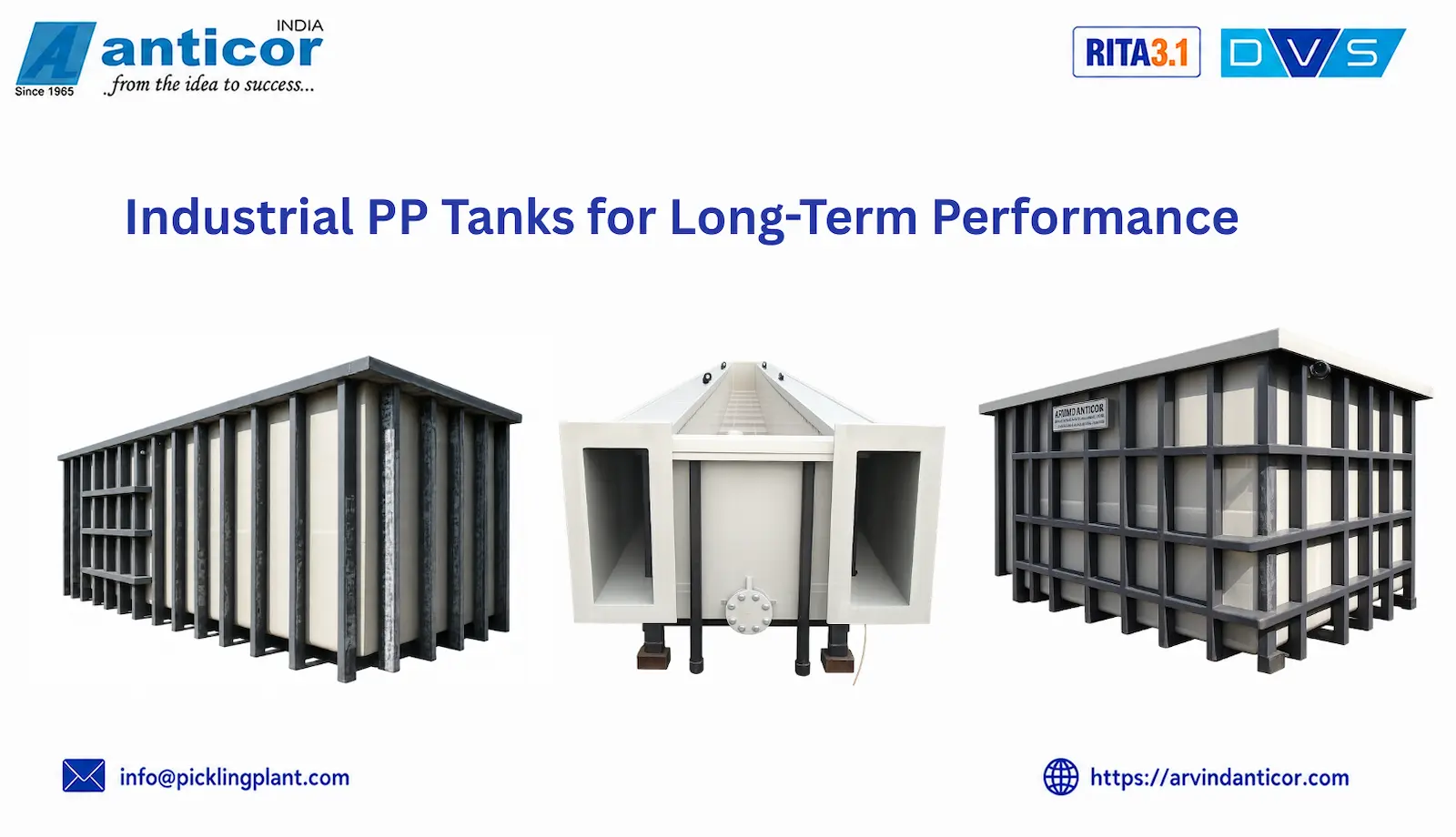
A PP tank, at its core, is a process or storage vessel built from polypropylene — a thermoplastic that holds up remarkably well against corrosive chemicals, mechanical stress, and the general wear and tear of an industrial floor. Most are sheet-welded, though some smaller units are rotationally moulded, and either way they end up holding things steel struggles with: acids, alkalis, process water, effluent, and other industrial chemicals, often for years, without needing a rebuild.
Since polypropylene starts life as virgin resin, pulled from oil or natural gas, manufacturers have a fair amount of control over how it behaves. Impact strength, wall thickness, UV stabilization, chemical grade. All of it can be dialled in depending on what’s going into the tank. That flexibility is a big part of why PP has quietly become the default material across process industries where long service life matters more than shaving a few rupees off the upfront cost. Well-engineered Polypropylene Pickling Tanks tend to show up wherever acid or alkali exposure is constant enough to chew through anything less resilient.
Technical Properties That Make PP Suitable for Industrial Use
Sheet thickness for these tanks usually falls somewhere between 6mm and 25mm, depending on how big the tank is, what pressure it’s under, and what it’s actually holding. A handful of properties tend to matter most:
- Operating temperature – PP holds up in continuous service up to roughly 80–100°C, which covers most hot pickling baths and elevated-temperature lines without issue
- Chemical compatibility – handles most mineral acids well (sulfuric, hydrochloric, nitric at moderate strength), along with alkalis and salts; solvents and strong oxidizers are more case-by-case
- Mechanical strength – good tensile and compressive strength for its weight, so tanks can hold serious volume without needing external reinforcement in most standard setups
- Fabrication flexibility – sheets weld into pretty much any shape you need: rectangular pickling tanks, cylindrical vessels, bunded tanks with secondary containment, multi-compartment layouts
- Low permeability – keeps vapour loss and fume generation down, which feeds directly into workplace safety and makes regulatory compliance a lot less of a headache
Because you can tune these properties during fabrication, very few PP pickling tanks are truly off-the-shelf. Most get built around the actual volume, concentration, and temperature profile of whatever process line they’re headed for.
Key Benefits of PP Pickling Tanks Over Steel and FRP
Set polypropylene next to mild steel, stainless steel, or FRP, and a few trade-offs start to favor PP pretty quickly — especially in plants dealing with corrosive chemicals day in and day out:
- Chemical resistance that doesn’t wear down, steel corrodes and pits under sustained acid or alkali exposure; PP just doesn’t, which removes one of the biggest causes of tank failure and contamination
- No lining needed – steel tanks handling anything corrosive usually need a rubber or PVC lining, and that lining is one more thing that can fail; PP skips that step entirely
- Less weight – per unit of capacity, PP tanks are considerably lighter than steel, which eases structural load requirements and makes installation simpler, particularly on upper floors or temporary setups
- Won’t rust, won’t shatter – no oxidation to worry about, and unlike glass-lined or FRP options, it holds up under mechanical impact without cracking
- Better lifetime cost – quicker to fabricate than steel, no lining to replace down the line, and fewer surprise shutdowns from corrosion-related failure
A Few More Reasons Plants Are Switching
Cost is usually the first thing that comes up. PP tanks are faster and cheaper to build than steel tanks of similar capacity, which matters a lot when a plant needs to scale up in a hurry. Selecting storage systems that meet established Chemical Storage Tank Requirements keeps that scaling from turning into a safety or compliance problem later.
There’s also a material-efficiency angle worth mentioning, low thermal expansion, low density, and solid mechanical strength. Put together, that means less raw material is needed to get the same structural performance steel would require, which adds up over a tank’s lifetime.
Fabrication flexibility is another one plants appreciate. Since PP sheet can be welded into nearly any geometry, tanks can be shaped around existing floor space or pipe routing instead of forcing a facility to redesign around a standard tank size.
Moisture resistance matters more than people expect, too. PP’s low permeability keeps ambient moisture from creeping into concentration-sensitive process chemicals during storage, something that genuinely affects process consistency in pickling and plating lines.
And maintenance, frankly, is just easier. No lining to inspect, no rust to chase down, and the tanks are light enough to move or reconfigure as a process line evolves. A lot of facilities pair theirs with an Acid Fume Extraction System as well, mainly to keep vapor under control and protect whoever’s working the floor.
PP vs. Polyethylene: Which Performs Better Under Load?
Both PP and polyethylene (PE) show up across water treatment, food processing, power generation, oil and gas, and waste disposal — but they’re not really substitutes for each other once you get into specifics. The gap comes down to density, stiffness, and strength.
PP has a higher softening point, so it’s the better call for hot processes like pickling baths running at elevated temperatures. PE tends to flex more and holds up slightly better against impact in cold conditions, which is part of why it’s often the go-to for outdoor storage in colder climates. For industrial pickling and chemical processing specifically — where heat and chemical exposure are more or less constant — PP’s stiffness and thermal performance usually wins out.
What Sets Polypropylene Apart, Technically
- Low moisture absorption keeps concentration-sensitive chemicals stable over long storage stretches
- Weather resistance holds up fine in outdoor installations across shifting climate conditions
- Wide temperature range covers both hot process baths and cold storage without a problem
- Thermal insulation helps keep internal process temperatures steady
- High tensile strength resists stretching or warping under hydrostatic load
- Strong compressive strength keeps walls from caving under pressure
- Dielectric properties provide electrical insulation, which matters for certain plating and electroplating setups
Industry Applications of PP Pickling Tanks
Steel and hot-dip galvanizing. This is probably the most common setting for PP tanks — pretreatment lines within a Hot Dip Galvanizing Plant rely on them for acid pickling, rinsing, and flux stages, where ongoing exposure to hydrochloric acid or sulfuric acid would eat through unlined steel fairly quickly. Plants running Chemical Storage Tanks for the Steel and Hot-Dip Galvanizing Industry generally size and configure each tank around whatever stage of the process it’s handling.
Petroleum and chemicals. These industries lean on PP for storing and processing acids, solvents, and intermediates — the corrosion resistance and low permeability cut down on both material loss and safety risk.
Plastics manufacturing. Even plastics plants use PP tanks — usually for process chemicals and cooling water — benefiting from the same corrosion resistance that makes them useful everywhere else.
Pharmaceuticals. Batch consistency here depends on storage that won’t leach anything or react with process fluids. PP’s inertness makes it a solid fit for both raw material storage and in-process holding.
Textile processing. Dyeing and finishing operations use PP tanks for acid and dye-bath storage, where consistent temperature tolerance directly shapes the quality of the final product.
Frequently Asked Technical Questions
What sheet thickness is typically used for PP pickling tanks? Usually somewhere between 6mm and 25mm, depending on tank volume, acid concentration, and operating temperature. Bigger tanks and hotter processes generally need thicker walls to stay structurally sound.
How long do these tanks last in a pickling application? With reasonable fabrication and upkeep, PP tanks in continuous acid service typically outlast unlined or poorly lined steel — mainly because there’s no corrosion or lining breakdown to manage over time.
Can they be built with secondary containment or bunding? Yes, and it’s fairly common. Bunded and multi-compartment configurations show up regularly in pickling lines and chemical storage setups where regulations call for containment in case something leaks.
Is capacity more limited than steel? Not really, for most industrial needs. PP tanks are built to custom volumes, and while very large single-vessel jobs might favour steel or concrete, PP covers the capacity range used in pickling, plating, and general process storage without trouble.
Why Choose Arvind Anticor for Industrial PP Tanks
We manufacture and export polypropylene pickling tanks across India, and we build each one around the specific chemical, temperature, and capacity needs of the process line it’s going into — not to a standard catalog size. Our tanks are in use across chemical storage, metal finishing, and pharmaceutical operations where performance under corrosive conditions simply isn’t negotiable.
Need a PP tank engineered for your process line? Get in touch with our team for a custom specification and quote.
Let’s Connect
Contact Us
We are live 24/7 and reply within 48 hours.
Get in Touch
-
-
-
Address
Survey No.584/1+2 – C,Nr. Akshar Industrial Estate Mahemdabad Highway Road,Vatva Ahmedabad-382445, Gujarat, India.