

Anyone who’s worked around a steel processing or hot-dip galvanizing plant knows the place runs on chemicals almost as much as it runs on steel. Acid handles pickling, degreasers strip off oil and grime, flux preps the surface, and passivation chemicals lock in the finish once galvanizing wraps up. Each one does a specific job, and most are aggressive enough to eat through the wrong container. That’s why storage isn’t something a plant can treat as an afterthought. Get it wrong, and you’re dealing with leaks, damaged infrastructure, safety incidents, or a line that grinds to a stop.
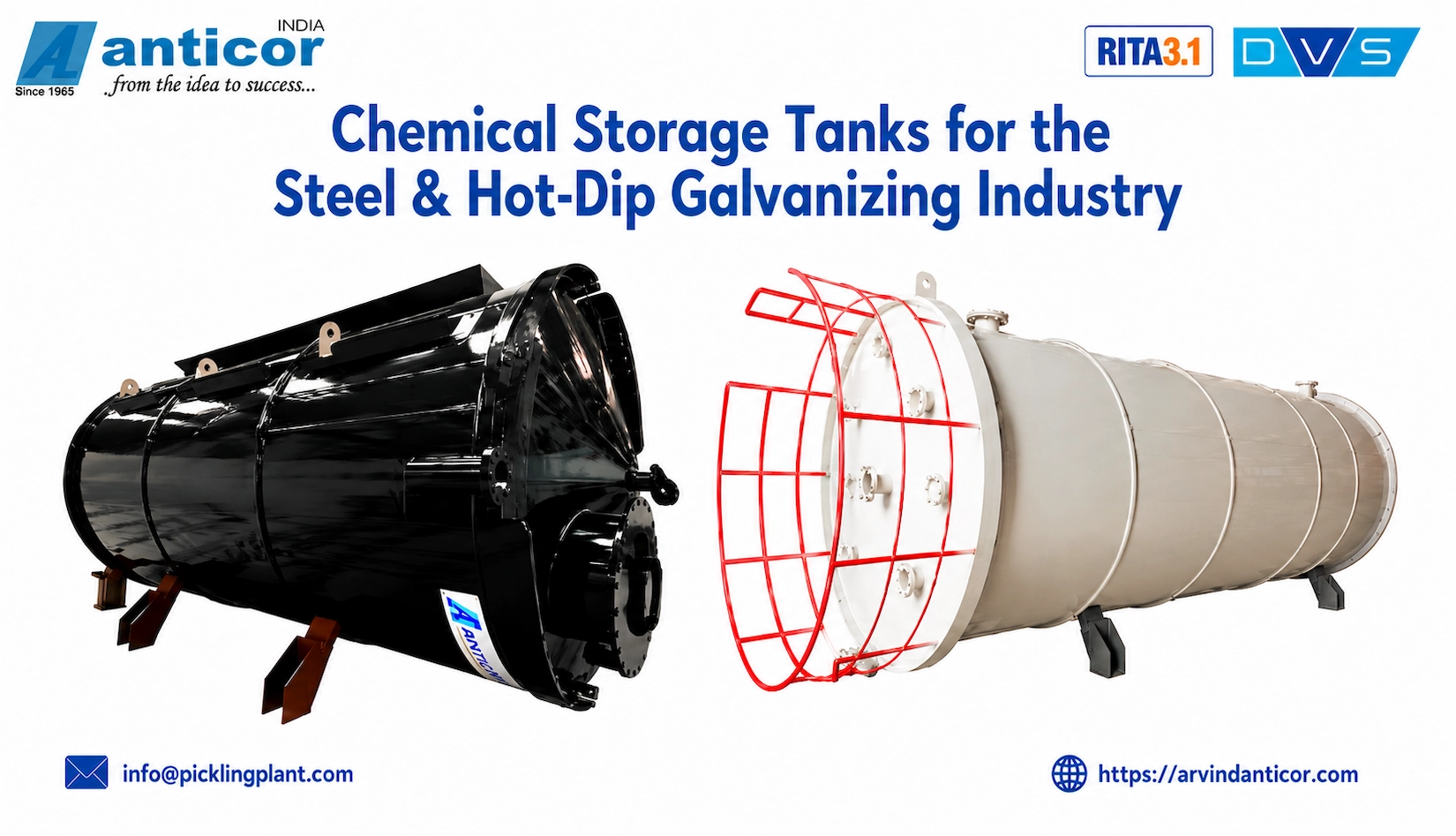
This is where dedicated chemical storage tanks come in, built to hold aggressive process chemicals without breaking down, keeping the chemistry stable, workers safe, and production moving without surprises. Most are made from polypropylene (PP), polypropylene homopolymer (PPH), HDPE, or FRP, materials that hold up in conditions where ordinary steel would corrode away within months. Which one makes sense depends on the chemical, where it sits in the process, and the conditions around it. Compatibility, operating conditions, and capacity all have to be weighed before settling on a material, and there’s rarely one answer that fits every plant.
Chemicals Used in Steel & Hot-Dip Galvanizing Plants
A typical plant moves steel through a sequence of chemical stages, each one meant to prep the surface, improve coating quality, or protect the finished product. Every chemical involved comes with its own storage quirks, and those quirks shape plant safety, efficiency, equipment life, and the quality of what comes off the line.
Hydrochloric acid (HCl) does the heavy lifting during pickling, stripping off rust, mill scale, and surface oxides. If storage lets the acid degrade, pickling gets shaky, and that tends to surface later as adhesion problems that are annoying to trace back.
Sulfuric acid hasn’t disappeared, even with HCl now dominating pickling. Some plants stick with it because of older equipment or process preferences built up over years. Storage needs shift with concentration and temperature, so it’s worth treating each setup on its own terms.
Degreasing chemicals strip oils and lubricants off the steel before acid work starts. Handle this stage well and pickling runs cleaner, with less contamination carried into the baths that follow.
Caustic soda handles alkaline cleaning, cutting through grease and stubborn residue. It’s effective but unforgiving, so proper storage matters both for keeping it working and avoiding accidental exposure.
Flux solution, typically zinc ammonium chloride, preps the steel right before it hits the molten zinc bath. Poor storage shows up as oxidation or coating defects, usually by the time the batch is already done.
Selecting Chemical Storage Tanks
Every chemical above has its own storage requirements based on its properties, concentration, temperature, and handling conditions. Choosing the right tank for each application matters for safe handling, efficient operation, reduced maintenance, and long-term reliability. Because these chemicals show up at different points in the process, selection should always be based on actual operating conditions rather than a generic default.
| Process Stage | Chemical Stored | Recommended Tank Material | Key Storage Consideration | Primary Selection Factor |
| Acid pickling | Hydrochloric acid (HCl) | PP / PPH | High corrosion resistance and secure containment | Acid concentration, temperature, and exposure duration |
| Acid pickling | Sulfuric acid | PP / PPH / FRP | Compatibility with acid strength and operating temperature | Chemical concentration and heat exposure |
| Degreasing / alkaline cleaning | Caustic soda and degreasing chemicals | HDPE / PP | Strong alkali resistance and contamination control | Chemical compatibility and cleaning cycle frequency |
| Fluxing | Zinc ammonium chloride flux solution | PP / PPH | Solution purity and controlled storage conditions | Contamination control and process consistency |
| Passivation | Passivation chemicals | PP / HDPE | Chemical stability and treatment effectiveness | Compatibility, storage temperature, and shelf stability |
| Utility / bulk storage | General process chemicals | PP / HDPE / FRP | Long-term durability and material compatibility | Capacity, layout, installation environment, and future expansion |
The right choice still depends on the exact chemical mix, operating temperature, storage capacity, and installation environment at your plant.
An engineering-based approach to tank selection pays off in better safety, longer equipment life, less maintenance, easier compliance, and steadier performance under demanding conditions. Get the material and configuration right and you protect the chemicals, cut downtime, and lower the total cost of ownership over the tank’s working life.
Why Thermoplastic Tanks Are Preferred
Picking the right tank material is one of the more consequential engineering decisions in a galvanizing plant, given how much corrosive chemicals demand in terms of reliability and compatibility. Thermoplastic tanks have become the default choice for a simple reason: they resist chemical attack well, last a long time, and keep performing even in tough environments.
A few specific advantages explain why:
- Chemical resistance. Thermoplastics hold up against hydrochloric acid, caustic soda, and a wide range of process solutions without breaking down.
- No corrosion. Unlike metal tanks, thermoplastics simply don’t rust, which removes a huge chunk of the maintenance work plants would otherwise face.
- Leak resistance. Modern welding techniques keep a well-made tank leak-tight for years, something older tank designs struggled with.
- Strength-to-weight ratio. Being relatively light makes these tanks easier to transport, install, and reposition later, without sacrificing structural strength.
- Lower maintenance. Less corrosion means fewer repairs, less downtime, and lower costs over the tank’s lifecycle.
- Long-term reliability. Properly engineered for the job, a thermoplastic tank keeps performing consistently well past its first few years.
Which specific material fits depends on what’s being stored. Polypropylene (PP) is the go-to for hydrochloric acid, flux, and general process chemicals, combining solid resistance with reasonable cost. Polypropylene homopolymer (PPH) steps in when rigidity or higher operating temperatures are involved. HDPE tends to get picked for alkaline chemicals, valued for its impact strength and durability alongside chemical resistance. FRP shows up in large-capacity installations or wherever extra structural strength is needed, sometimes with a corrosion-resistant liner depending on what’s stored inside.
Picking the right material means weighing compatibility, concentration, temperature, capacity, and installation conditions together, rather than focusing on just one factor.
Engineering Considerations for Tank Design
Choosing a corrosion-resistant material is just the starting point. Designing a system that actually holds up takes a lot more.
Chemical compatibility and process conditions. Concentration, temperature, filling cycles, and exposure duration all shape how well a tank performs long-term. Hot HCl may call for a different material or design than the same acid at room temperature, so working through these conditions early supports long-term structural performance.
Operating temperature. Chemicals move through a plant at different temperatures depending on how operations are structured. Tanks need to be built for the actual expected range, not some average that looks fine on paper.
Tank capacity and plant layout. Storage capacity should track production throughput, consumption rates, replenishment frequency, and available space. Getting sizing right optimizes layout and keeps operations running without interruption.
Installation environment. Outdoor tanks need protection against UV exposure and weather. Indoor tanks need proper ventilation and enough clearance for people and equipment to move safely.
Safety and regulatory compliance. Venting, overflow protection, level monitoring, and secondary containment aren’t optional at any real scale. Everything needs to comply with applicable industry standards and environmental regulations.
Future expansion. As facilities scale up or add new lines, storage requirements grow with them. Designing with expansion in mind minimizes modification costs and simplifies integrating new equipment later.
Working through these factors during planning keeps a storage system safe, reliable, and adaptable for the plant’s full lifecycle, not just the first year or two.
Common Storage Challenges
Storage systems in this industry work under genuinely demanding conditions, and a few problems tend to come up again and again.
Premature tank failure and leakage. Tanks exposed to aggressive chemicals over long periods can wear out early if they weren’t designed for the specific application. Weakened joints and aging materials raise leak risk, bringing safety concerns, downtime, and unplanned repair costs. Well-engineered systems paired with routine inspection keep this risk in check.
Contamination and reduced efficiency. Poor storage or a deteriorating tank reduces chemical effectiveness, increases consumption, and throws off consistency in the operations that follow. Clean, well-maintained storage keeps the whole process stable.
Downtime and maintenance headaches. An unexpected tank failure disrupts chemical supply to critical stages, and in high-volume facilities even a short interruption ripples through productivity fast. Durable storage combined with proactive maintenance reduces these disruptions.
Storage needs outgrowing the plant. As production scales up, storage capacity often doesn’t keep pace without deliberate planning, and retrofitting a layout that was never designed for expansion tends to be expensive.
Fixing these problems takes more than swapping in a new tank after something breaks. It comes down to investing in well-engineered systems that improve reliability and keep production steady as the plant’s needs evolve.
Why Choose Arvind Anticor
Arvind Anticor Limited has spent more than three decades building thermoplastic chemical storage tanks and corrosion-resistant process equipment for the steel and hot-dip galvanizing plant. The company runs its operations out of a 150,000 sq. ft. manufacturing facility, follows DVS-compliant thermoplastic fabrication practices, and uses RITA 6.0 design software to engineer tanks suited to each plant’s specific needs. Backed by strict quality checks and serious manufacturing capability, the company supplies storage solutions across a wide range of capacities and configurations.
Conclusion
Chemical storage tanks aren’t a background detail in steel and galvanizing operations, they’re central to keeping chemical handling safe, operations efficient, and infrastructure reliable. Choosing the right tank material and design, matched to compatibility, operating conditions, and future plant needs, pays off through better safety, lower maintenance, and steadier production throughout the galvanizing process.
With over three decades in the industry, Arvind Anticor Limited continues to design and manufacture thermoplastic chemical storage tanks and corrosion-resistant process equipment for the steel and hot-dip galvanizing industry, backed by engineering, precision manufacturing, and a genuine commitment to quality that keeps operations running safely and efficiently.
Let’s Connect
Contact Us
We are live 24/7 and reply within 48 hours.
Get in Touch
-
-
-
Address
Survey No.584/1+2 – C,Nr. Akshar Industrial Estate Mahemdabad Highway Road,Vatva Ahmedabad-382445, Gujarat, India.