

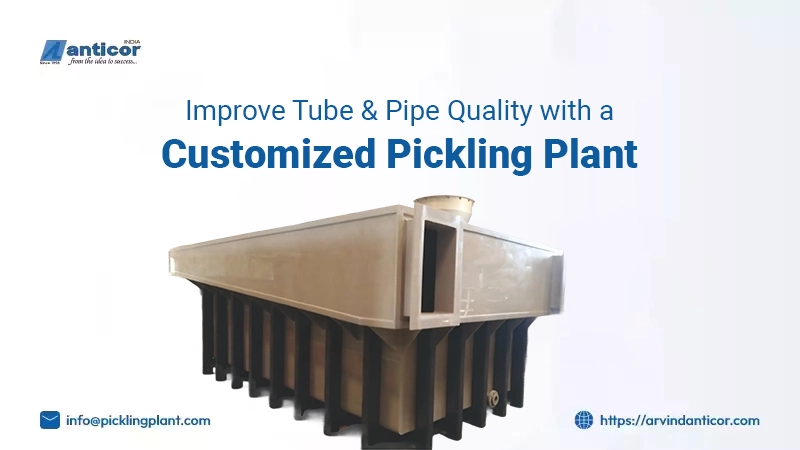
In industries where tubes and pipes are critical to performance, surface quality directly influences durability, safety, and downstream processing. Whether pipes are used for galvanizing, fabrication, or infrastructure projects, consistent surface preparation is essential. This is where a customized pickling plant becomes a key part of the production process rather than just a support operation.
A properly engineered pickling plant for tubes and pipes ensures uniform cleaning, better corrosion resistance, and dependable results across batches. When the system is designed around real production conditions, manufacturers gain better quality control and long-term operational stability.
What Impacts Tube and Pipe Surface Quality?
During rolling, forming, and heat treatment, tubes and pipes naturally develop scale, oxide layers, and surface impurities. These contaminants interfere with coating adhesion, welding quality, and overall service life.
Mechanical cleaning alone is often not enough to remove firmly bonded oxides. Chemical pickling provides a controlled and effective way to prepare the surface, making it a standard step in modern tube and pipe manufacturing.
Why Pickling Plays a Critical Role in Manufacturing
Pickling removes surface scale and oxides, leaving behind a clean and reactive metal surface. In a well-designed tube and pipe pickling plant, parameters such as immersion time, temperature, and chemical concentration are carefully controlled to ensure consistent results.
This controlled approach improves coating performance, reduces rejection rates, and supports longer component life, especially in demanding operating environments.
Limitations of Standard Pickling Setups
Many manufacturers begin with standard pickling equipment, only to encounter challenges such as production scales or product mix changes. Fixed tank sizes, limited handling flexibility, and basic safety provisions can restrict productivity and affect consistency.
When pipe dimensions vary or output increases, standard systems often struggle to maintain uniform quality. A customized pickling plant addresses these issues by aligning design, layout, and capacity with actual operating needs.
How a Customized Pickling Plant Improves Consistency
Process Flow Matched to Production Requirements
A customized system is designed around pipe length, diameter, and throughput. Tank dimensions and handling arrangements are optimized to ensure every tube and pipe receive uniform treatment, reducing variation between batches.
Material Selection for Reliable Operation
Material selection directly impacts plant life and maintenance requirements. Polypropylene-based systems are widely used due to their resistance to aggressive chemicals and long service life. Many manufacturers evaluate material choices by understanding the benefits of polypropylene pickling tanks before finalizing their plant design.
For continuous operations, polypropylene pickling tanks provide a stable and low-maintenance solution suitable for harsh industrial environments
Safety and Fume Control Integration
Pickling involves the handling of strong chemicals, making safety a critical design consideration. Proper ventilation, enclosure design, and fume management are integrated into the system layout to protect operators and maintain compliance.
Seamless and Welded Pipe Processing Considerations
Different pipe constructions require different handling approaches. Seamless pipes demand uniform internal and external surface treatment, while welded pipes require careful attention around weld seams.
A well-designed pickling plant for tubes and pipes ensures consistent surface quality regardless of pipe type, supporting reliable downstream processes such as coating, galvanizing, and forming.
Applications That Benefit from Proper Pickling
Pickled tubes and pipes are widely used in galvanizing plants, infrastructure projects, chemical pipelines, and industrial fabrication. In applications where surface cleanliness and corrosion resistance are critical, specialized solutions such as pickling tanks for stainless steel pipes help maintain performance standards
Planning for Future Production Needs
As production requirements evolve, flexibility becomes increasingly important. Modular systems allow manufacturers to expand capacity, introduce automation, or modify layouts without major redesigns.
Many manufacturers prefer a turnkey execution approach, where design, fabrication, installation, and commissioning are handled as one coordinated process. This approach helps ensure system compatibility and smoother project execution, as outlined in this guide on how to set up a turnkey pickling plant.
Conclusion
Maintaining consistent tube and pipe quality requires more than basic cleaning. A properly engineered customized pickling plant delivers uniform surface preparation, improved durability, and reliable performance across a wide range of applications. By matching plant design to production requirements, manufacturers can achieve better quality control and long-term efficiency.
At Arvind Anticor Limited, we design and manufacture pickling solutions that support efficient tube and pipe processing while meeting stringent safety and performance expectations. With the right system in place, manufacturers can confidently meet demanding industrial standards.
Let’s Connect
Contact Us
We are live 24/7 and reply within 48 hours.
Get in Touch
-
-
-
Address
Survey No.584/1+2 – C,Nr. Akshar Industrial Estate Mahemdabad Highway Road,Vatva Ahmedabad-382445, Gujarat, India.