

Rust, mill scale, general grime. Metal picks all of it up during manufacturing, and it keeps picking up more just from being stored or shipped. None of that comes off on its own, and none of it should be there when a part goes in for galvanizing, plating, painting, or any other finish. That’s what the pickling process is for. An acid bath strips the surface back to bare metal so whatever comes next actually has something to bond to.
We’ll get into the mechanics of the pickling process: which acids get used and why, how it’s actually run on a working line, and the handful of variables that decide whether the result is clean or costly.
What Is Pickling?
At its core, the pickling process is a controlled soak in acid. The solution, often called pickle liquor, dissolves rust and oxide scale off a metal part’s surface. It’s usually the step right before galvanizing, plating, or coating, not something done in isolation.
For carbon steel specifically, that means hydrochloric acid or sulfuric acid, depending on the shop and the job. This is what’s generally meant by chemical pickling: the acid reacts with and eats into the oxide layer, breaking it loose from the base metal underneath. Once that’s done, the part comes out and gets rinsed thoroughly before moving on. Skip the rinse, or rush it, and you’re carrying leftover acid into whatever process comes next, which is its own problem.
Why This Step Sets Up Everything After It
You can knock some scale off mechanically, with wire brushes or blasting, but the stuff that’s really bonded to the surface tends to stay put. An acid pickling process handles that differently, through a chemical reaction rather than abrasion, and it gets into spots mechanical cleaning misses.
Hot-dip galvanizing is a good example of why this matters. Pickling happens right after degreasing, before the steel ever touches flux. Zinc doesn’t bond to a surface that’s still carrying oxide. Modern turnkey hot dip galvanizing plants are built around this dependency, with pickling as a fixed, controlled stage rather than something bolted on. So if pickling is done poorly, or skipped, the whole galvanizing step downstream is compromised, no matter how well everything else is controlled.
What You Actually Get Out of It
Cleaner surfaces, first and foremost. Rust and mill scale come off, leaving bare metal for the next process to work with.
That cleanliness carries through. Galvanizing and coating both depend on it, since zinc or a coating material won’t adhere properly to a surface that’s still got residue on it. The same logic drives how manufacturers improve tube and pipe quality with a customized pickling plant, where uniform surface prep across every length of pipe is the whole point.
There’s a consistency angle, too. A well-run pickling process produces a fairly uniform surface across a whole batch of parts. That said, it cuts both ways. Leave parts in the bath too long, or run the acid too concentrated, and you start eating into the base metal itself. Pitting, roughness, material loss, none of which anyone wants to explain to a customer.
The Pickling Process, Step by Step
Every shop runs this a little differently depending on the metal, the equipment, and what happens after pickling. But the basic shape of the pickling process for metal is usually the same.
Degreasing comes first. Oil, grease, dirt, whatever’s on the part from machining or handling, needs to come off before the metal ever sees the acid bath. Alkaline cleaning or a solvent wash, depending on what the shop has set up. In a typical galvanizing line, this is followed by a rinse before the part even reaches pickling.
Then immersion. The part goes into the acid, hydrochloric or sulfuric for most steel work, and sits there while the acid dissolves the scale. How long depends on a few things: how strong the acid is, how hot the bath is, and how thick the scale is to begin with. This step needs watching. Leave a part in too long, and you’re not cleaning it anymore, you’re damaging it.
Rinsing follows immediately. This one gets treated as an afterthought sometimes, which is a mistake. Any acid or dissolved contaminant left on the surface can interfere with whatever comes next, especially if that next step is another chemical process.
What happens after that depends entirely on the application. In galvanizing, the part moves into a flux bath, which helps remove any remaining oxide and keeps the surface from re-oxidizing before it hits the molten zinc. Elsewhere, pickled metal might go straight to coating, plating, welding, or forming.
What Determines Pickling Performance
A few variables decide whether the pickling process goes well or badly.
Acid choice and strength matter most. Hydrochloric and sulfuric are the standard picks for steel, and how concentrated the solution is has a direct bearing on how fast scale comes off.
Temperature plays a role too. Sulfuric acid usually runs hot. Hydrochloric acid works fine at room temperature for most steel jobs, which is part of why it’s popular.
Time in the bath is a balancing act. Long enough to clear the scale, short enough that the acid doesn’t start working on the steel itself. There’s no fixed number here. It depends on the material and what condition it came in.
And then there’s the part itself. Thicker scale takes longer, different metals react differently, and whatever happened to the part before it reached pickling, prior heat treatment or storage conditions, factors in as well.
Where Does the Spent Acid Go?
Pickling solution wears out. As it works, it picks up dissolved iron and other byproducts, and at some point it stops being effective and needs to be swapped out or regenerated.
Spent acid isn’t something you just pour down a drain. It has to go through proper industrial waste treatment, and a lot of facilities run recovery systems that pull usable material back out of the spent solution rather than losing it entirely. Makes sense financially as much as environmentally.
The Tank Is Part of the Chemistry
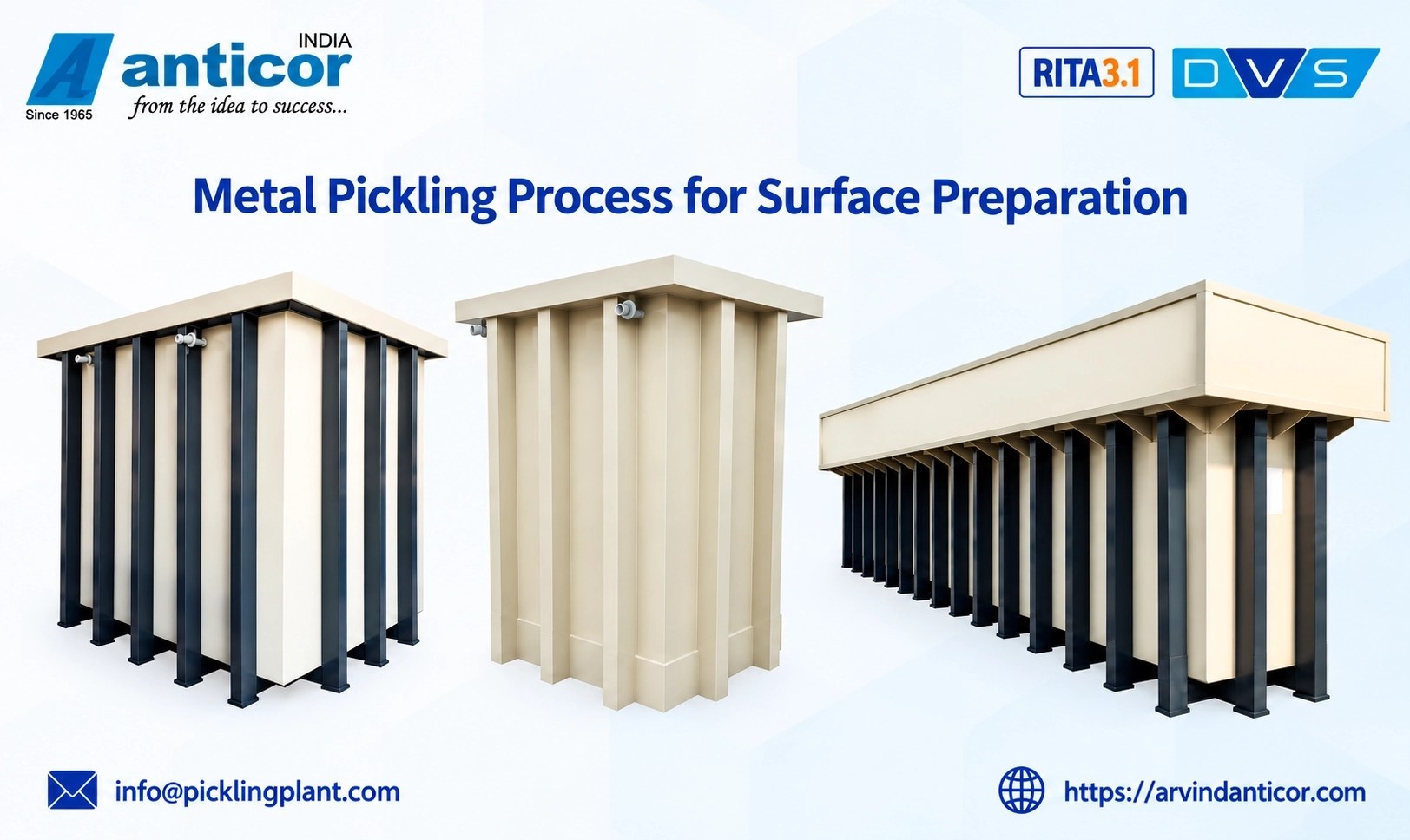
None of this works without equipment built for it. The tank holding that acid has to stand up to the chemicals, the temperatures, and whatever throughput the line demands, and getting that wrong is an expensive mistake to discover after the fact. Buyers weighing this decision usually end up working through the same short list of questions, covered in more depth in this buyer’s guide to industrial pickling tanks.
Material is usually where that decision starts. For a lot of applications, polypropylene pickling tanks end up as the default choice, mainly because they hold up under sustained acid exposure without the lining and maintenance headaches steel tanks bring with them.
Conclusion
The pickling process is the step that makes everything possible after it is. Galvanizing, coating, plating, none of it works well on a surface that’s still carrying rust or scale. Get the acid, the temperature, the timing, and the rinse right, and the result is a clean, consistent surface batch after batch.
At Arvind Anticor, we understand that the equipment behind the process matters just as much as the chemistry itself. A pickling system that’s actually built for the job keeps conditions under control, keeps the chemicals handled safely, and keeps quality where it needs to be.
Let’s Connect
Contact Us
We are live 24/7 and reply within 48 hours.
Get in Touch
-
-
-
Address
Survey No.584/1+2 – C,Nr. Akshar Industrial Estate Mahemdabad Highway Road,Vatva Ahmedabad-382445, Gujarat, India.