

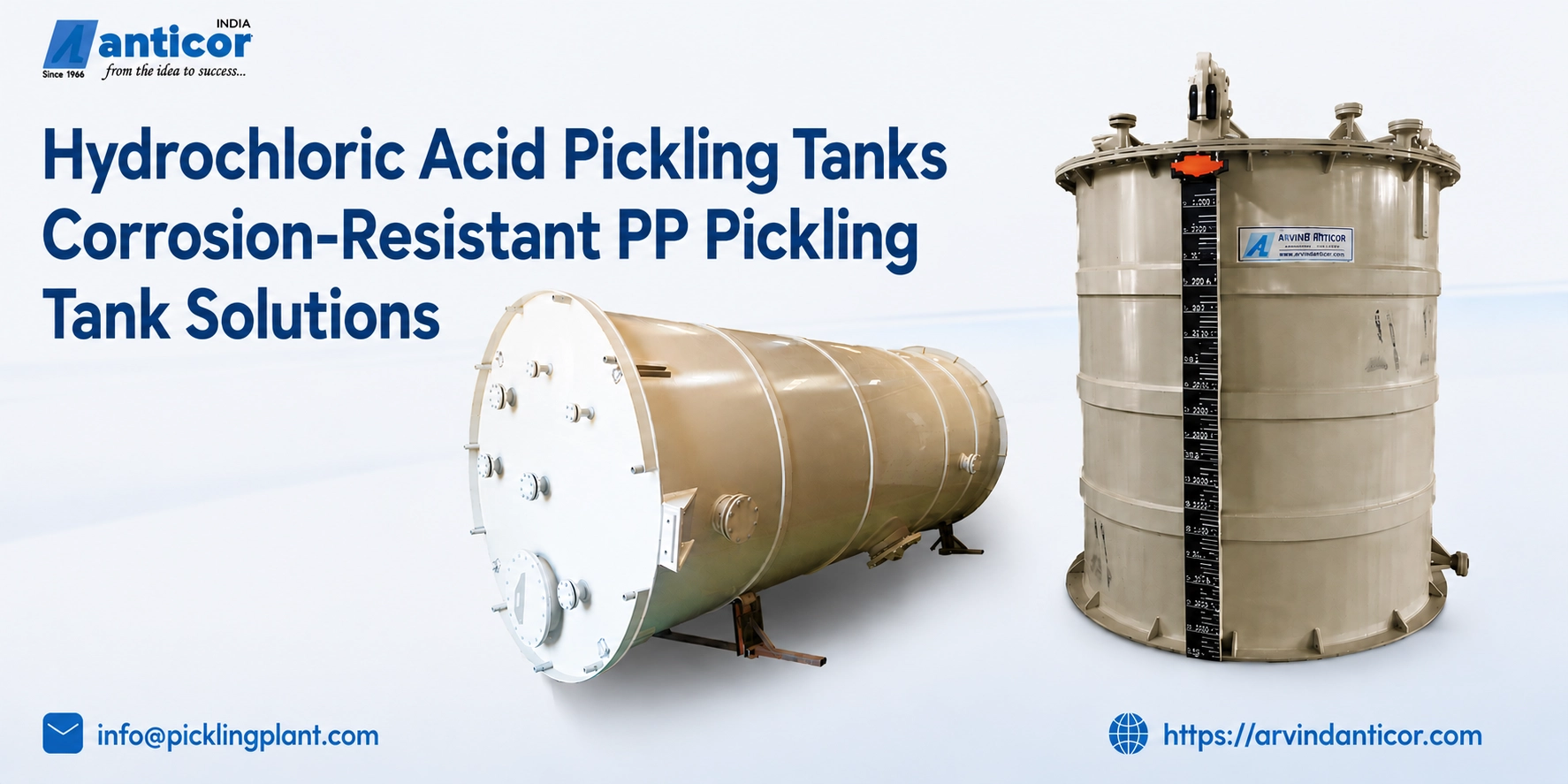
The acid pickling process is an essential part of modern metal surface treatment industries where rust, mill scale, oxides, and surface contaminants must be removed before galvanizing, coating, fabrication, or further processing. Industries such as steel processing, wire manufacturing, pipe production, and hot-dip galvanizing rely heavily on efficient pickling systems to maintain product quality and operational consistency.
Since hydrochloric acid is highly corrosive, selecting the right HCL storage tank and pickling system becomes critical for ensuring process safety, chemical resistance, and long-term durability. Industrial environments involving continuous acid exposure, temperature fluctuations, and corrosive fumes demand carefully engineered acid storage tank solutions that can withstand demanding operating conditions.
Modern Hydrochloric Acid Pickling Tanks are therefore designed not only for chemical containment but also for structural stability, operational safety, ventilation integration, and long service life. Proper material selection, precision fabrication, and efficient fume extraction systems all play an important role in maintaining reliable industrial pickling operations.
What Is an HCL Storage Tank Used in the Acid Pickling Process?
An HCL storage tank is a specialized industrial tank designed for the safe storage and handling of hydrochloric acid in metal processing applications. These tanks are commonly integrated into the acid pickling process, where hydrochloric acid is used to remove rust, oxidation, welding scale, and surface impurities from metal components before further processing.
Hydrochloric acid pickling tanks are widely used in steel processing plants, wire manufacturing industries, tube and pipe production facilities, galvanizing plants, and various metal pretreatment operations. Compared to conventional acid storage tank systems, pickling tanks operate under more demanding conditions due to continuous acid circulation, temperature variation, operational loading, and exposure to corrosive fumes.
Because of these operating conditions, industrial pickling systems require corrosion-resistant materials, reliable fabrication quality, and properly engineered structural support to maintain long-term operational performance and safety.
Major Design Challenges in HCL Storage Tank Manufacturing
Chemical Corrosion Resistance
One of the biggest challenges in HCL storage tank manufacturing is handling the highly corrosive nature of hydrochloric acid. Continuous exposure to acidic chemicals can lead to structural degradation, leakage, premature failure, and increased maintenance costs if improper materials are used.
To improve long-term durability, modern acid storage tank systems are commonly manufactured using corrosion-resistant thermoplastic materials such as PP, PPH, and HDPE. These materials offer excellent resistance against hydrochloric acid and acidic fumes, helping improve chemical compatibility, operational safety, corrosion resistance, and long-term structural reliability in industrial acid pickling process applications.
Acid Fume Generation
During the acid pickling process, hydrochloric acid fumes are continuously generated inside the pickling area. These corrosive vapors can affect worker safety, damage nearby equipment, and accelerate plant corrosion if not properly controlled.
To minimize these risks, modern Hydrochloric Acid Pickling Tanks are commonly integrated with:
- wet scrubbers,
- ventilation ducts,
- and controlled airflow arrangements.
Efficient ventilation helps maintain safer working conditions while reducing corrosion-related damage within the facility.
Thermal Expansion and Structural Stability
Industrial PP pickling tank systems are often exposed to varying operating temperatures and continuous chemical loading conditions. Over time, these operating variations can create thermal expansion stress within the tank structure.
Without proper engineering support, tanks may experience deformation, stress cracking, dimensional instability, or reduced structural performance during long-term operation. To improve stability and durability, industrial acid storage tank systems are manufactured with reinforced external supports and optimized structural designs capable of handling demanding industrial conditions.
Weld Joint Strength and Leakage Prevention
Weld joint quality plays an important role in the reliability of an HCL storage tank. Poor fabrication can increase the risk of leakage, structural weakness, and maintenance issues during long-term industrial operation.
PP pickling tank systems commonly use butt fusion welding and DVS welding standards to achieve uniform, chemically resistant joints capable of handling continuous acid exposure and operational stress. Proper weld consistency also helps maintain long-term dimensional stability in large industrial tank structures.
Why PP and PPH Materials Are Preferred for Acid Storage Tank Systems
Material selection plays a critical role in the performance and durability of any acid storage tank used in industrial pickling operations. Among thermoplastic materials, PP and PPH are widely preferred because they offer strong chemical resistance, fabrication flexibility, and long-term structural reliability in corrosive industrial environments.
In Hydrochloric Acid Pickling Tanks, PP and PPH materials provide excellent resistance against hydrochloric acid and acidic fumes while also offering lightweight construction, lower maintenance requirements, and easier custom fabrication. These properties make them highly suitable for industrial acid pickling process applications where continuous chemical exposure and operational stress are common.
A PP pickling tank can also be customized according to:
- production capacity,
- plant layout,
- structural reinforcement requirements,
- ventilation integration,
- and drainage system design.
This flexibility allows manufacturers to design systems that match specific industrial operating conditions and process requirements.
HDPE is also used in selected applications because of its chemical resistance and durability. However, the final material selection generally depends on factors such as operating temperature, acid concentration, tank dimensions, and overall process conditions.
Compared to conventional metallic systems, thermoplastic acid storage tank solutions typically offer better corrosion resistance, lower maintenance requirements, and longer operational service life.
Importance of DVS Welding Standards in PP Pickling Tank Fabrication
The performance of a PP pickling tank depends not only on material selection but also on welding quality. In industrial acid pickling process applications, tanks are continuously exposed to chemical pressure, temperature variation, and operational stress, making weld integrity a critical factor in long-term reliability.
DVS welding standards are commonly used in thermoplastic tank fabrication to maintain consistent weld quality and structural strength. Proper butt fusion welding helps create uniform joints that reduce the risk of leakage, weak connection points, and fabrication defects.
In large HCL storage tank systems, welding precision becomes even more important because uneven joints or poor fabrication can affect dimensional stability and operational safety over time. Properly welded thermoplastic tanks offer better durability, improved leak resistance, and more reliable long-term performance in corrosive industrial environments.
Ventilation Systems in the Acid Pickling Process
Proper ventilation is essential in every acid pickling process because hydrochloric acid fumes can spread rapidly within industrial facilities.
Modern pickling systems commonly integrate:
- acid fume extraction systems,
- wet scrubbers,
- extraction hoods,
- and ducting systems.
These systems help capture and neutralize corrosive fumes before they affect the surrounding environment.
Importance of Proper Ventilation
Efficient ventilation systems help improve workplace safety, environmental compliance, equipment protection, and overall plant efficiency. Integrated ventilation planning during the HCL storage tank design stage also helps optimize long-term operational reliability.
Customization Requirements for Industrial Pickling Systems
Every industrial acid pickling process operates under different production and operating conditions. Factors such as production volume, acid concentration, plant layout, and workflow often require customized engineering solutions.
Customized Hydrochloric Acid Pickling Tanks are commonly designed based on:
- tank dimensions,
- production capacity,
- structural reinforcement requirements,
- ventilation integration,
- drainage arrangements,
- and chemical handling conditions.
Importance of Customized System Design
Turnkey pickling systems allow industries to integrate tanks, scrubbers, ducting, and process equipment into a single engineered solution. This helps improve installation efficiency, operational coordination, and future process scalability.
Custom-engineered systems also provide better flexibility for plant expansion and process optimization.
Maintenance and Safety Considerations
Proper maintenance is essential for ensuring the long-term performance of any Chemical Storage Tank used in industrial applications.
Regular inspection of weld joints, structural supports, ventilation systems, drainage arrangements, and tank surfaces helps identify operational issues before they create downtime or safety risks.
Operational Safety Measures
Preventive maintenance also helps improve operational lifespan and maintain process stability. In industrial acid pickling process environments, proper acid handling, controlled ventilation, overflow management, and operational safety procedures all play an important role in maintaining safe and reliable plant operation.
Choosing the Right Hydrochloric Acid Pickling Tank Manufacturer
Selecting the right manufacturer is critical for ensuring long-term operational performance and reliability. Industrial Hydrochloric Acid Pickling Tanks require more than standard fabrication because these systems must handle aggressive chemicals, continuous operational stress, and demanding industrial conditions.
Manufacturers experienced in PP pickling tank fabrication, DVS welding standards, thermoplastic engineering, and turnkey pickling solutions are generally better equipped to deliver reliable and durable systems. Factors such as fabrication quality, customization capability, engineering expertise, ventilation integration, and after-sales support should all be carefully evaluated before selecting an acid storage tank solution provider.
Conclusion
The performance of any HCL storage tank used in the acid pickling process depends heavily on proper engineering, corrosion-resistant material selection, welding precision, and ventilation integration. From chemical resistance and structural stability to fume extraction and leakage prevention, every aspect of tank design directly impacts operational safety and long-term plant efficiency.
At Arvind Anticor Limited, we manufacture customized PP, PPH, and HDPE Hydrochloric Acid Pickling Tanks for demanding industrial applications. With advanced thermoplastic fabrication capabilities, DVS welding standards, and turnkey process solutions, we deliver corrosion-resistant systems designed for long-term operational reliability, safety, and efficient acid handling performance.
Let’s Connect
Contact Us
We are live 24/7 and reply within 48 hours.
Get in Touch
-
-
-
Address
Survey No.584/1+2 – C,Nr. Akshar Industrial Estate Mahemdabad Highway Road,Vatva Ahmedabad-382445, Gujarat, India.