

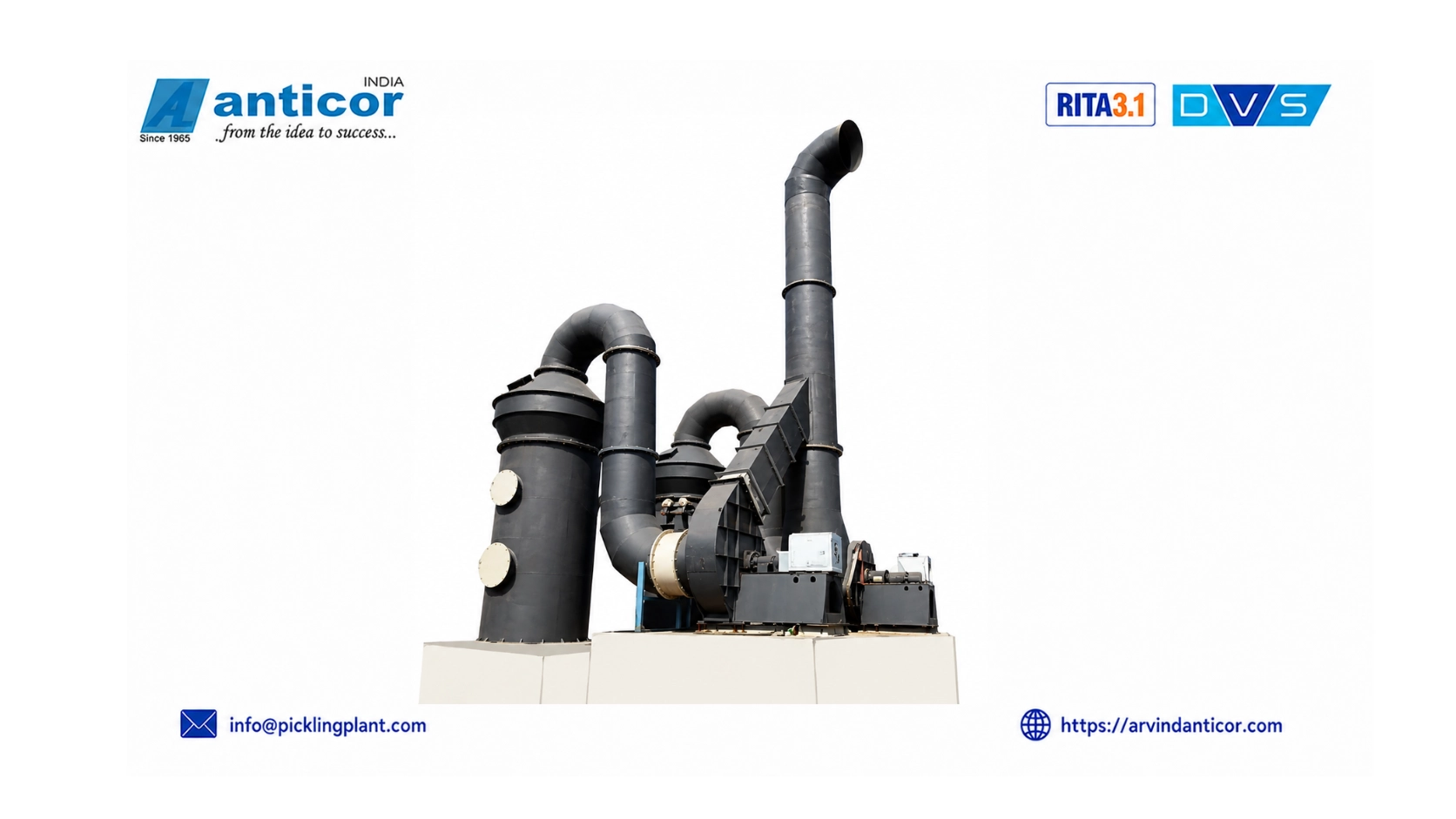
Acid fume extraction systems are a vital part of any pickling or galvanizing plant. Whether you’re working with hydrochloric acid, sulfuric acid, or other corrosive chemicals, the fumes generated during surface treatment processes pose serious risks to worker safety, equipment life, plant infrastructure, and regulatory compliance.
Most of these problems can be avoided if they’re caught at the design stage. This guide walks through what actually goes into an efficient acid fume extraction system, from airflow calculations to material selection, so you’re not stuck reworking a system after it’s already installed.
At Arvind Anticor, we’ve built these systems for pickling and galvanizing plants across India and abroad. We work with thermoplastics, DVS-certified welding, and RITA 6.0 simulation software to make sure a system performs the way it’s supposed to from day one.
Key Design Factors in Acid Fume Extraction Systems
Designing an effective acid fume extraction system takes more than picking a hood and hooking up a blower. You need a real understanding of the chemical process involved, how the plant is laid out, and what the operation actually demands day to day. Below are the design elements that tend to make or break performance and long-term reliability.
1. Type and Concentration of Acid Fumes
Hydrochloric, sulfuric, nitric, phosphoric — each acid produces fumes with its own level of corrosiveness and toxicity, and the design has to account for that. This means looking at:
- How reactive the fumes are
- Expected fume volume and temperature
- Health and environmental risks specific to that chemical
Getting this right shapes everything downstream: the neutralization method, the materials used, and how much capacity the system needs.
2. Process Layout and Source Proximity
A good extraction system is built around where the tanks, kettles, and reaction zones actually sit on the floor. Get the hood placement wrong and you end up with dead zones where fumes slip past the extraction points and into the workplace instead.
We look closely at:
- Open surface area of tanks or kettles
- Equipment height and spacing
- How accessible the area is for ducting and maintenance
- How air already moves through the plant
3. Airflow and Suction Velocity
Fumes have to be captured before they spread out into the room, which means the airflow has to be sufficient — not approximate. An undersized blower or a duct run that wasn’t calculated properly will result in weak suction no matter how good the rest of the design is. This is where we focus on:
- Calculating air changes per hour (ACH)
- Setting the right suction velocity (usually 0.3–0.5 m/s for open tanks)
- Routing ducts to keep pressure loss to a minimum
We run these numbers through RITA 6.0 to simulate how the system will actually perform before anything gets fabricated.
4. Ducting and Hood Configuration
The ducting itself, its shape and the material it’s made from, has a lot to do with whether you end up with backflow, corrosion, or leaking fumes down the line. A few things worth getting right:
- Hood type — lip, canopy, or slot, depending on the process
- Duct length and bends, keeping elbows and friction losses to a minimum
- Diameter sizing that keeps airflow balanced
- Material — PP, FRP, HDPE, or dual laminate, chosen for chemical compatibility
5. Material Selection for System Durability
Every part of the system, hoods, ducts, scrubbers, all of it, needs to hold up against corrosion and deformation over years of use, not months. Depending on the application, we use:
- Polypropylene (PP) for most acid fumes
- HDPE where temperatures are lower and chemicals less aggressive
- FRP where structural strength and UV resistance matter
- Hybrid builds for harsher environments
The material choice here has a direct effect on how long the system lasts and what it costs to maintain.
️ NEW SECTION
Components of an Acid Fume Extraction System
An extraction system is really five parts doing one job together: hoods, ducting, a blower, a scrubber, and an exhaust stack. Get one wrong and the rest end up compensating for it.
The hood has to sit right over the source, the tank, the kettle, wherever the reaction’s happening. Tight spaces usually call for a slot hood. Open tanks with room to spare, canopies or lips work better.
Ducting is the part people underrate. Wrong diameter and you lose velocity. Too many sharp bends and you lose pressure. Wrong material and you’re replacing sections within a year. PP handles most acid fumes fine. HDPE’s good for cooler runs. FRP earns its keep when you need real strength.
Blowers are where sizing mistakes get costly. Undersized, fumes just linger instead of getting pulled in. Oversized, you’re burning power you didn’t need and adding turbulence that throws off the process.
The scrubber’s the last stop before anything hits open air. It neutralizes the acid vapors, and it protects the ductwork and stack downstream from corrosion too. Packed bed, venturi, or crossflow, depends on the chemistry.
System Sizing and Capacity Planning
Sizing is probably the most underrated part of designing an acid fume extraction system, and getting it wrong in either direction causes real problems. Too small and it can’t keep up. Too large and you’re paying for capacity you don’t need. These errors may not show up on day one. They tend to surface later as unexplained corrosion, higher energy bills, or fumes drifting into the workspace even though the system is running.
Why Sizing Matters
A system that’s too small tends to:
- Fail to capture fumes effectively
- Let acid condense inside the ducts
- Corrode faster and need more frequent maintenance
A system that’s too large tends to:
- Burn more energy than it needs to
- Create turbulence that throws off process stability
- Add capital cost without adding much benefit
What you’re aiming for is airflow that matches the plant’s actual requirements — not more, not less.
What We Consider During Sizing
We size each system based on real numbers from the plant, not rules of thumb. That includes:
- Number and size of process tanks or kettles
- Open surface area exposed to acids
- How long each process runs and how often batches occur
- Ceiling height and room volume
- Fume generation rate, based on temperature and concentration
- Required air changes per hour (ACH) for that particular zone
Running these through RITA 6.0 lets us simulate how the system holds up under real load, which cuts down on trial and error once it’s actually installed.
Capacity Planning for Growth
Plants change. Operations expand, throughput increases, and a system designed only for today’s numbers can end up limiting what a plant can do two years from now. We build in room for:
- Modular expansion
- Reserve blower capacity
- Duct routing with spare ports already in place
It costs less to plan for this upfront than to retrofit it later.
Scrubber Integration and Neutralization Strategy
Extracting the fumes is only the first half of the job. What happens to them afterward matters just as much. A proper system includes a wet scrubber that neutralizes the acid vapors before any air gets released into the atmosphere.
Why Scrubbers Matter
Skip the scrubber and fumes carrying hydrochloric acid, sulfuric acid, or zinc oxide particles will:
- Corrode ductwork and exhaust stacks over time
- Add to air pollution
- Put the plant at risk of non-compliance with applicable environmental and workplace safety requirements
A scrubber isn’t just about emissions — it protects the rest of the fume handling system from chemical damage that would otherwise shorten its life.
How Arvind Anticor Designs Scrubber Integration
We build thermoplastic wet scrubber systems specifically for pickling and galvanizing applications. Each one is:
- Engineered for acid neutralization efficiency
- Built around Arvind Anticor’s zero discharge philosophy
- Made from corrosion-resistant PP or FRP
- Integrated directly with the extraction system for flow control
Depending on the chemistry involved, we’ll recommend packed bed, venturi, or crossflow scrubbers, each paired with the right neutralizing media.
Learn more: For a closer look at how scrubbers work, check out our blog: How Wet Scrubbers Work in Industrial Fume Extraction.
Why Choose Arvind Anticor
There’s a lot riding on picking the right partner for a system like this — performance, reliability, compliance, all of it. We don’t just sell equipment. We design complete systems built around what a pickling or galvanizing plant actually needs.
Custom Engineered for Your Operations
Every project starts with a consultation. Our team looks at your plant layout, process parameters, chemical usage, and airflow needs before designing anything, so the system fits your production environment rather than the other way around.
Corrosion Resistant Material Expertise
Components are built from industrial-grade thermoplastics — polypropylene (PP), high-density polyethylene (HDPE), and fiber reinforced plastic (FRP). Which one we use depends on your chemical environment, and it’s what determines how long the system lasts and how much upkeep it needs.
DVS-Certified Welding Standards
We fabricate to DVS welding standards for thermoplastics, which means leak-proof joints and solid mechanical strength. That translates to a system that holds up under continuous operation.
Precision Design with RITA 6.0
RITA 6.0 handles our airflow modeling, pressure drop calculations, and performance simulations, so the system is properly sized and balanced before we ever start fabrication.
Industry Experience and Reach
Decades in the business of supplying turnkey solutions for galvanizing and pickling plants have given us a strong footprint across India and international markets. Manufacturers who care about safety, compliance, and efficiency tend to come back to us.
Conclusion
An efficient acid fume extraction system depends on getting the basic things right: airflow, material selection, fume capture, and treatment. When these are planned properly from the beginning, the system can control fumes effectively, protect plant infrastructure, and support safer day-to-day operations.
At Arvind Anticor, we design and manufacture complete acid fume extraction systems for pickling and galvanizing plants. These include extraction hoods, ducting, blowers, wet scrubbers, and exhaust stacks. We use thermoplastic fabrication, DVS welding standards, and RITA 6.0-based design and simulation to develop each system according to the requirements of the plant.
Let’s Connect
Contact Us
We are live 24/7 and reply within 48 hours.
Get in Touch
-
-
-
Address
Survey No.584/1+2 – C,Nr. Akshar Industrial Estate Mahemdabad Highway Road,Vatva Ahmedabad-382445, Gujarat, India.