

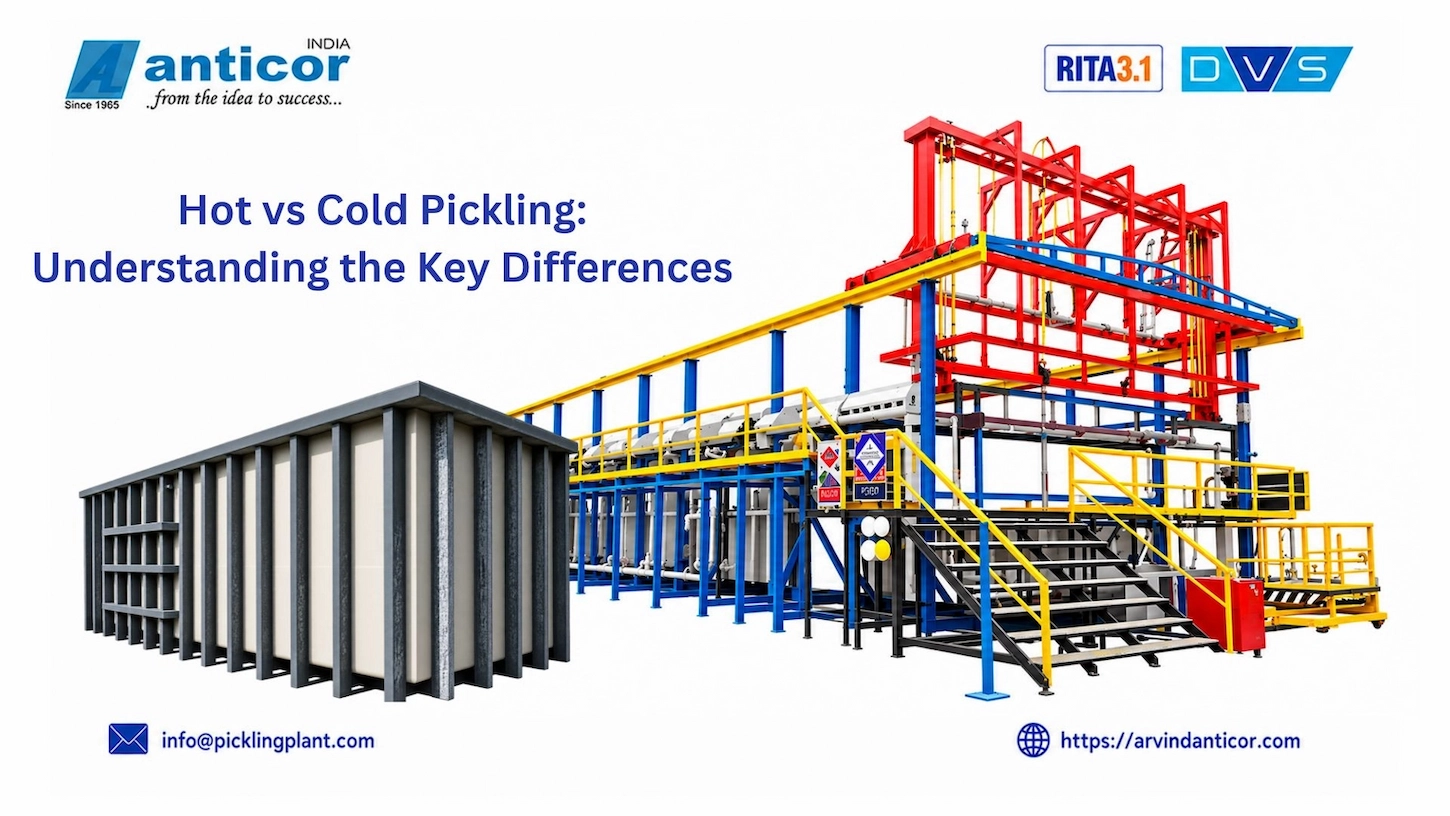
Anyone who runs a galvanizing plant will immediately bring up pickling. If your steel is taking too long to pickle, then you will experience a bottleneck with rinsing, fluxing and putting your steel into your zinc kettle. If poorly managed, you may also experience extra waste of acid and rework.
There are a number of considerations to think about when choosing between hot pickling or cold pickling. Knowing the differences between the two can help you choose the right system to suit your production. The Hot vs Cold Pickling decision can also affect your production schedule, utility costs, tank requirements, and emissions.
Hot and Cold Pickling
Pickling is an important process when preparing the surface of steel. Mill scale, rust and oxides need to be removed in order for the next coating to stick. This is achieved by dipping the material in an acid solution. This acid pickling process is an essential stage before galvanizing, coating or plating.
Hot pickling uses heat to control the process. Some sulphuric acid processes will run at around 60-80°C. Due to the higher temperature of the solution, the reaction speeds up, meaning less time in the tank. This can help increase utilization of your tanks if you have a high-volume production line. This is the main benefit of the Hot Pickling Process. If you have a production line where cycle times are a concern, this could provide a useful benefit. You would want to confirm whether the Hot Pickling Process offers enough improvement to justify the additional heating requirements.
However, you will require the system to include heating, insulation and controls. Your tank will also need to be constructed from materials able to handle the higher temperatures. You will also need to factor in fume extraction.
Cold Pickling
The Cold Pickling Process uses the solution at ambient or near-ambient temperatures. Hydrochloric acid is commonly used.
As there is no heating system, this can make the system simpler. However, the reaction will generally be slower and you may need to increase the soak time. The speed of the reaction depends on various factors, such as the scale condition, acid concentration and steel type. You would want to know what conditions you will be using so you can plan the process.
Cold pickling can be a good option if you are a job-shop galvanizer or have small batches. However, if you have enough tank capacity, this could be the way to go. Ensure you have the right-sized line for your production. A properly sized Cold Pickling Process can work well for many batch operations without the need for dedicated bath heating.
Hot vs Cold Pickling: Key Differences
The hot vs cold pickling decision usually comes down to the balance between treatment time and the cost and complexity of heating.
| Factor | Hot Pickling | Cold Pickling |
| Bath temperature | Elevated; around 60-80°C in some applications | Ambient or near-ambient |
| Reaction speed | Generally faster | Generally slower |
| Heating required | Yes | Normally no |
| Heating-related energy use | Higher | Lower |
| Typical fit | Higher-throughput operations | Batch and moderate-volume operations |
| Fume generation | Can be higher | Generally lower, but extraction is still required. |
This is a general guide. The reaction speed will depend on the acid concentration, steel type and scale thickness. You would want to ensure you have the correct pickling bath temperature for your chemical and steel type. With a heated bath, the temperature should be suitable for the acid chemistry and steel condition.
Other Considerations
Production
Whilst the temperature of the solution can affect how quickly your process runs, a well-planned cold line may still get you to your required daily output. You would want to ensure your industrial pickling process matches your production. Don’t assume you need a heated system; ensure you have the right-sized line.
Consider how your steel will flow through your plant. After pickling, you may need to rinse and flux your steel. If one stage is slower than another, you will have delays. The number of tanks, their size, crane movement and handling will all have an impact. This is where good planning can improve overall pickling line efficiency.
Surface Finish
Just because it is quicker does not mean it will give you a better finish. The goal of pickling is to remove the oxide without having the acid attack the steel. Ensuring you have the right balance will help you get a consistent finish from your steel pickling process. This is important prior to galvanizing, coating or plating.
The finish will depend on the scale thickness, steel type, acid concentration and iron in solution. Having regular checks will help you keep control. Consistent monitoring is important to ensure you have a reliable steel pickling process.
Costs
Pickling will incur costs for acid, energy, labour, maintenance, fume extraction and effluent treatment. It can be useful to look at the costs per tonne of your pickled steel. This will help you get a better idea when evaluating your industrial pickling process and comparing different line options.
With hot pickling, you will have extra costs for heating, insulation and controls. This may be justified if you are getting more output due to quicker cycles. With cold pickling, you will not need dedicated heating for your solution, but you would want to factor in the longer soak times.
Where possible, use real data from your plant to get a fair comparison between hot and cold pickling. Try to collect information on how many tonnes you process, how much acid you add, how much energy you use, labour hours, maintenance and waste.
Tanks
Industrial pickling tanks will operate in a corrosive environment, so you would want to ensure they are made from the right material. Polypropylene (PP) and PPH are commonly considered due to their chemical-resistant properties. The material will depend on the type of acid, concentration, temperature and size of the tank.
The design will need to consider the weight of the liquid, support arrangements, thermal effects and quality of fabrication. These requirements are particularly important when selecting industrial pickling tanks for a new production line.
If you are considering a new line, our guide to different types of pickling tanks and their applications can help you understand the most common setups and where they are used.
Fumes
Both processes can create acid fumes. Heated solutions will create more vapours, so you may need more extraction. However, cold pickling will still require good ventilation.
With a suitable acid fume extraction system, fumes can be captured close to the tank and sent to a scrubber. The extraction system should be sized to match your tank setup, acid chemistry and operating conditions. This should be considered with any industrial pickling process. It is easier to include it from the start.
Storage and Effluent
You want to ensure you have safe storage for your fresh acid, spent acid and acidic rinse water. Ensure you have correctly specified chemical storage tanks for your chemical, concentration and required volume.
You will also need the correct effluent treatment capacity for the amount of wastewater produced during pickling and rinsing. These arrangements should be considered as part of your overall industrial pickling process.
Final Thoughts
The decision between hot and cold pickling will depend on your situation. Hot pickling can help reduce processing time and get more steel through a busy line. Cold pickling does not require a dedicated heating system and can work well with batch processes. The right Steel Pickling Process will depend on your material, production schedule, site, and overall cost of running your line.
At Arvind Anticor Limited, we manufacture bespoke thermoplastic pickling tanks and offer chemical handling and industrial pollution control systems. Our team can help you understand what tank size and ancillary equipment you will need based on how your plant runs.
Let’s Connect
Contact Us
We are live 24/7 and reply within 48 hours.
Get in Touch
-
-
-
Address
Survey No.584/1+2 – C,Nr. Akshar Industrial Estate Mahemdabad Highway Road,Vatva Ahmedabad-382445, Gujarat, India.