

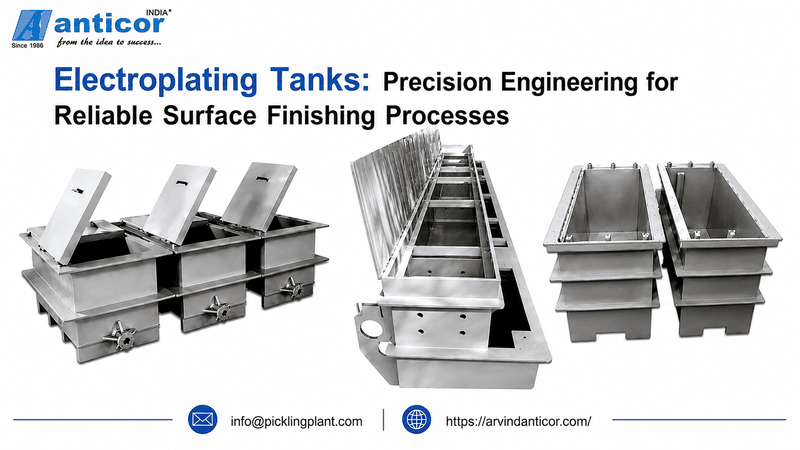
Electroplating is a widely used surface treatment process that enhances the corrosion resistance, wear resistance, conductivity, and appearance of metal components. Industries such as automotive, electrical, electronics, fasteners, and precision engineering rely on electroplating to improve product durability and performance. At the center of every electroplating line are electroplating tanks, which safely contain process chemicals and maintain the controlled conditions required for consistent metal deposition.
The performance of an electroplating tank depends on its material selection, structural design, and fabrication quality. Among the available materials, polypropylene (PP) is widely preferred for its excellent chemical resistance, durability, and fabrication flexibility. This guide explains the role of electroplating tanks, the key stages of the electroplating process, material options, design considerations, and the factors that contribute to reliable, long-term performance.
Understanding the Role of Electroplating Tanks
An electroplating tank is the primary process vessel where electrochemical reactions deposit a thin layer of metal onto a workpiece. It safely contains the electrolyte solution while maintaining the stable chemical, thermal, and operating conditions required for consistent metal deposition. The quality and design of the tank directly influence coating performance, process efficiency, and operational reliability.
During electroplating, components are immersed in an electrolyte solution containing dissolved metal ions. When an electric current passes through the solution, these ions bond to the component’s surface, forming a uniform metal coating that improves corrosion resistance, wear resistance, conductivity, or appearance, depending on the application.
Beyond supporting the plating process, electroplating tanks are designed to withstand continuous exposure to corrosive chemicals while maintaining safe operating conditions and consistent production quality throughout the electroplating line.
How Electroplating Tanks Improve Process Efficiency and Product Quality
The performance of an electroplating process depends not only on the plating chemistry but also on the quality of the electroplating tank. A well-engineered tank provides the stable conditions required for consistent metal deposition, helping manufacturers achieve reliable coating quality while improving operational efficiency.
Industries benefit from well-engineered electroplating tanks by:
- Maintaining stable chemical concentration and operating conditions.
- Achieving uniform coating thickness and better adhesion.
- Reducing contamination and process variations.
- Minimizing maintenance and unplanned production downtime.
- Extending equipment service life through superior chemical resistance.
- Improving workplace safety with leak-proof construction.
- Supporting reliable and consistent electroplating operations.
By supporting a stable and efficient plating process, well-engineered electroplating tanks contribute to consistent product quality, lower operating costs, and long-term production reliability.
Electroplating Tanks Across the Surface Treatment Process
The electroplating process consists of several stages, each requiring a dedicated process tank designed to handle specific chemicals and operating conditions. Together, these tanks ensure consistent coating quality, safe chemical handling, and efficient production.
| Process Stage | Purpose | Tank Requirement |
| Degreasing | Removes oils, grease, dust, and surface contaminants before plating. | Compatible with alkaline cleaning solutions while maintaining controlled operating conditions. |
| Pickling & Activation | Removes rust, oxides, and mill scale while activating the metal surface for plating. | Requires excellent chemical resistance for continuous exposure to acidic solutions. |
| Electroplating | Deposits a protective or decorative metal coating onto the prepared component. | Maintains stable solution chemistry, operating temperature, and electrical conditions. |
| Rinsing | Removes residual chemicals and prevents cross-contamination between process baths. | Supports efficient water flow, drainage, and reduced chemical carryover. |
| Passivation & Finishing | Enhances corrosion resistance, surface appearance, and product durability. | Designed to handle specialized finishing chemicals while ensuring consistent treatment quality. |
Degreasing Tanks
The electroplating process begins with degreasing, where contaminants such as oils, grease, and dust are removed from the workpiece. Effective cleaning prepares the metal surface for subsequent treatment and helps ensure strong coating adhesion.
Pickling and Activation Tanks
After degreasing, components are transferred to pickling and activation tanks, where acidic solutions remove rust, oxides, and mill scale while preparing the metal surface for electroplating.
Electroplating Tanks
Electroplating tanks form the core of the plating line, where metal ions are deposited onto the component through an electrochemical process. Stable operating conditions are essential for achieving uniform coating thickness, strong adhesion, and consistent product quality.
Rinse Tanks
Rinse tanks remove residual chemicals after each treatment stage, preventing cross-contamination between process baths. Efficient rinsing also helps preserve solution quality and supports more sustainable water usage.
Passivation and Finishing Tanks
The final stage includes passivation or other finishing treatments that improve corrosion resistance, enhance surface appearance, and extend product life. These treatments help manufacturers meet the performance and quality standards required across various industries.
Material Selection for Electroplating Tanks
The performance and service life of an electroplating tank largely depend on the material used in its construction. Since electroplating involves continuous exposure to corrosive chemicals, varying operating temperatures, and demanding process conditions, selecting the right material is essential for ensuring long-term durability, operational safety, and reliable performance.
The table below compares the most commonly used materials for electroplating tanks
| Material | Key Advantages | Typical Applications |
| Polypropylene (PP) | Excellent chemical resistance, lightweight construction, easy fabrication, and long-term durability. | Electroplating tanks, pickling tanks, and other process tanks. |
| FRP (Fiber Reinforced Plastic) | High mechanical strength, corrosion resistance, and suitability for large process equipment. | Large process tanks and structural applications. |
| HDPE (High-Density Polyethylene) | Good chemical resistance, high impact strength, and reliable performance in selected applications. | Chemical storage and selected process applications. |
Among these materials, polypropylene (PP) is the preferred choice for electroplating tanks due to its excellent chemical resistance, structural durability, and fabrication flexibility. Its lightweight construction simplifies installation, while its superior weldability enables the fabrication of leak-proof tanks in various sizes and configurations. These characteristics help maintain solution purity, reduce maintenance requirements, and support long-term operational reliability.
FRP is often selected for applications requiring additional structural strength or larger process equipment, while HDPE is commonly used for chemical storage and selected process applications operating within its recommended temperature range. Selecting the appropriate material requires careful evaluation of chemical compatibility, operating temperature, structural requirements, and process conditions to achieve optimum performance throughout the equipment’s service life.
Key Design Considerations for Electroplating Tanks
Designing an electroplating tank requires careful consideration of process chemistry, operating conditions, production requirements, and long-term operational performance. A well-engineered tank not only supports consistent plating quality but also improves safety, reliability, and maintenance efficiency throughout its service life.
Chemical Compatibility
The construction material must be compatible with the chemicals used throughout the electroplating process. Different plating solutions, acids, alkalis, and cleaning chemicals require materials that can resist chemical attack without compromising structural integrity. Selecting the right material helps ensure safe operation and long-term reliability.
Tank Size and Capacity
Tank dimensions should be determined based on component size, production volume, handling methods, and available plant space. Properly sized tanks improve production efficiency, optimize chemical usage, and allow for smoother workflow within the electroplating line.
Structural Reinforcement
Electroplating tanks are designed to withstand the weight of process chemicals, workpieces, and continuous operating loads. Proper structural reinforcement prevents deformation, maintains stability under hydrostatic pressure, and ensures reliable long-term performance, particularly for large-capacity tanks.
Temperature Requirements
Many electroplating processes require controlled operating temperatures to achieve uniform metal deposition. Tank designs should accommodate heating systems while maintaining structural stability during continuous heating and cooling cycles to ensure consistent plating quality.
Overflow, Drainage, and Maintenance Access
Efficient overflow systems, proper drainage arrangements, and easy maintenance access simplify routine cleaning, chemical replacement, and inspection. These design features help reduce contamination, minimize maintenance downtime, and improve overall operational efficiency.
Ventilation and Auxiliary Equipment Integration
Electroplating tanks should be designed to integrate seamlessly with heating systems, filtration units, rectifiers, chemical dosing equipment, and acid fume extraction systems. Proper integration improves process control, supports a safer working environment, and allows for easier maintenance and future system upgrades.
Planning for Future Expansion
Production requirements often evolve over time. Designing electroplating tanks with future expansion in mind allows manufacturers to increase capacity or incorporate additional process equipment with minimal disruption, protecting long-term operational investment.
Applications of Polypropylene Electroplating Tanks
Polypropylene electroplating tanks are widely used across industries that require enhanced corrosion resistance, improved wear protection, better electrical conductivity, or decorative metal finishes. Their versatility and ability to support a wide range of surface treatment processes make them suitable for diverse industrial applications.
| Industry | Typical Applications | Purpose of Electroplating |
| Automotive | Fasteners, brackets, brake parts, fuel system components, and decorative trims | Improves corrosion resistance, durability, and appearance. |
| Electrical & Electronics | Connectors, terminals, busbars, switchgear components, and electronic hardware | Enhances electrical conductivity, solderability, and corrosion resistance. |
| Fasteners & Industrial Hardware | Bolts, nuts, screws, washers, and industrial hardware | Increases wear resistance and extends product life. |
| Aerospace & Precision Engineering | Precision components and aerospace parts | Ensures accurate metal deposition and consistent coating quality. |
| Consumer & Architectural Products | Sanitary fittings, furniture hardware, lighting fixtures, and decorative components | Improves aesthetics, durability, and long-term performance. |
The versatility of polypropylene electroplating tanks allows manufacturers to customize tank sizes, configurations, and process layouts to suit specific production requirements. Their reliable performance and long service life make them a preferred solution for both new installations and plant expansion projects.
Choosing the Right Manufacturing Partner for Electroplating Tanks
Selecting the right electroplating tank is only one part of building an efficient and reliable surface treatment system. Equally important is choosing a manufacturing partner with the technical expertise to design and fabricate tanks that meet your specific process requirements.
When evaluating an electroplating tank manufacturer, consider the following:
- Experience in manufacturing corrosion-resistant process equipment.
- Expertise in thermoplastic fabrication and custom tank design.
- Compliance with recognized welding and fabrication standards.
- Capability to manufacture customized tank sizes and configurations.
- Comprehensive quality inspection and performance testing.
- Engineering support from design through installation.
- Ability to integrate tanks with heating systems, filtration units, ventilation, and fume extraction systems.
Choosing a manufacturer with proven engineering capabilities helps ensure reliable equipment performance, safer plant operations, and long-term production efficiency.
Conclusion
Electroplating tanks play a critical role in achieving consistent coating quality, safe chemical handling, and efficient surface treatment operations. Selecting the right tank requires careful evaluation of material compatibility, engineering design, process requirements, and the expertise of the manufacturing partner to ensure reliable results and maximize equipment life.
With over three decades of experience in manufacturing corrosion-resistant thermoplastic process equipment, Arvind Anticor designs and manufactures customized polypropylene electroplating tanks that meet the demanding requirements of modern surface treatment industries. Every solution is engineered to deliver durability, safety, and consistent process performance, helping industries build reliable and future-ready electroplating systems.
Let’s Connect
Contact Us
We are live 24/7 and reply within 48 hours.
Get in Touch
-
-
-
Address
Survey No.584/1+2 – C,Nr. Akshar Industrial Estate Mahemdabad Highway Road,Vatva Ahmedabad-382445, Gujarat, India.