

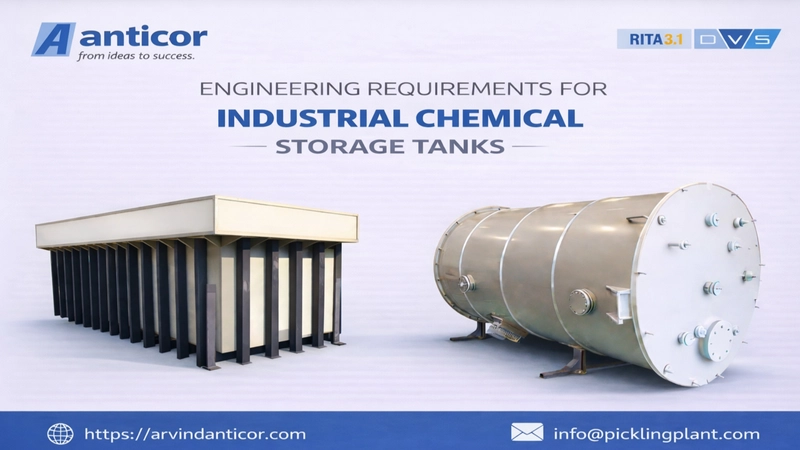
Chemical storage tank requirements vary across industries due to differences in chemical exposure, temperature conditions, regulatory obligations, and operational intensity. An industrial chemical storage tank used in a steel pickling line operates under entirely different stresses compared to one installed in a water treatment plant or power facility.
For this reason, industrial chemical storage tank systems must be engineered with careful attention to structural calculations, material compatibility, and fabrication integrity. A generalized approach often leads to premature failure, leakage, and avoidable downtime, making it essential to design systems based on specific chemical environments and operating conditions.
What Defines a Compliant Chemical Storage Tank?
A compliant system is defined by adherence to chemical storage tank requirements and precise engineering practices used in industrial chemical storage tank design. Factors such as chemical compatibility, operating conditions, and long-term performance must be carefully evaluated, along with other things to consider when buying chemical storage tanks.
Design Standards
Tank design must account for hydrostatic load, chemical density, operating temperature, and environmental exposure. Structural calculations determine appropriate wall thickness, reinforcement requirements, and safety factors for a reliable industrial chemical storage tank.
Material Compatibility
Stored chemicals such as acids, alkalis, and solvents demand verified compatibility with the selected material. Incompatible materials often experience stress cracking, degradation, or structural weakening over time, directly impacting chemical storage tank requirements.
Welding Quality
Joint integrity plays a critical role in leak prevention. Butt-fusion welding and hot gas extrusion welding, when executed under DVS-compliant procedures, significantly enhance long-term seam reliability in industrial chemical storage tank systems.
Structural Calculations
Reinforcement ribs, support structures, and bottom radius design must be evaluated according to tank height and liquid load. Improper structural planning can result in deformation in long rectangular industrial chemical storage tank configurations.
Safety Built into Engineering
Venting provisions, overflow systems, nozzle reinforcement, and secondary containment must be integrated at the design stage to meet critical chemical storage tank requirements.
Material Selection & Corrosion Resistance
Material selection is critical in meeting chemical storage tank requirements, as it directly impacts corrosion resistance, structural stability, and long-term performance of an industrial chemical storage tank. Factors such as chemical compatibility, temperature conditions, and fabrication quality must be considered to ensure reliable operation in aggressive industrial environments.
Selecting the right system also depends on working with an experienced chemical storage tanks manufacturer who can ensure proper design, material selection, and fabrication of quality based on application requirements.
Proper evaluation is especially important when handling corrosive chemicals. Our detailed guide on acid storage tank material compatibility explains how different thermoplastic materials perform under varying chemical conditions.
Common material strategies include:
• HDPE for cost-effective bulk storage and impact resistance
• Polypropylene for moderate temperature chemical handling
• PPH or PPC for higher rigidity and structural strength
• FRP for elevated temperature or reinforced structural demand
• Tank-within-tank systems for hazardous containment
Typical Material Selection Across Industries
| Industry | Common Chemicals Stored | Preferred Tank Materials | Key Engineering Considerations |
| Chemical Manufacturing | Nitric acid, sulfuric acid, solvents | PP, PPH, FRP | Corrosion resistance, chemical storage tank requirements compliance |
| Steel & Galvanizing | Hydrochloric acid, flux solutions | PP, PPH | Structural reinforcement for long industrial chemical storage tank systems |
| Water Treatment | Sodium hypochlorite, alum | HDPE, PP | UV resistance, purity protection |
| Power & Energy | Boiler chemicals, DM water | FRP, PP | Temperature resistance, venting control |
| Automotive | Pickling acids, Phosphating chemicals | PP, PPH | Thermal stability, modular tank design |
| Construction & Infrastructure | Water, liquid admixtures | HDPE, FRP | Outdoor durability, low maintenance |
Industry-Specific Chemical Storage Tank Requirements
Chemical Industry
The chemical industry operates with highly corrosive and reactive substances, making strict adherence to chemical storage tank requirements essential. An industrial chemical storage tank in this sector must handle continuous chemical exposure while ensuring safety, structural stability, and regulatory compliance.
Commonly stored chemicals include nitric acid (HNO₃), hydrochloric acid (HCl), sulfuric acid (H₂SO₄), caustic soda (NaOH), solvents, and other hazardous process chemicals. Storage capacities typically range from 500 to 50,000 liters, using vertical cylindrical tanks, horizontal tanks, rectangular process tanks, and conical bottom tanks for complete drainage.
These systems operate under ambient to elevated temperatures depending on process conditions. Installations may be indoor or outdoor, often arranged in tank farms with secondary containment and UV exposure considerations.
Key engineering requirements include:
• Butt fusion-welded, DVS-compliant construction
• Custom wall thickness based on chemical load
• Leak-proof fabrication for hazardous applications
• Integration of level indicators and safety fittings
In facilities handling volatile or corrosive chemicals, proper ventilation is essential. Many plants integrate acid fume extraction systems to capture and treat chemical vapors generated during storage and processing.
Improper material selection or fabrication often results in corrosion, leakage, and reduced service life, especially in continuously exposed environments.
Steel & Galvanizing Industry
The steel and galvanizing industry requires highly durable industrial chemical storage tank systems due to continuous exposure to aggressive acids and process chemicals. Meeting chemical storage tank requirements in this sector is critical for maintaining process efficiency and minimizing downtime.
Chemicals handled include hydrochloric acid (HCl), mixed acids, sulfuric acid, flux solutions, degreasing chemicals, rinse water, and passivation chemicals. Tank configurations are primarily long rectangular process tanks, often extending up to 40 meters, along with vertical and horizontal storage tanks.
Operations involve ambient to elevated temperatures, including heated pickling tanks under continuous acid exposure. These systems are typically installed within indoor production lines with modular site assembly.
In stainless steel processing, dedicated pickling tanks for SS pipe are engineered to handle continuous chemical exposure while maintaining structural integrity over long spans.
For galvanizing applications, surface preparation plays a critical role. As explained in pretreatment tanks for hot dip galvanizing tank design directly impacts coating adhesion and process efficiency.
Key engineering requirements include:
• Weld-less bottom radius for durability
• Hot gas extrusion and butt fusion welding
• Stress-relieved thermoplastic construction
• Reinforced long-span rectangular structures
Improper tank design can lead to weld failures, structural deformation, and corrosion-related shutdowns, directly affecting production continuity.
Water Treatment Industry
Water and wastewater treatment plants rely on industrial chemical storage tank systems for storing raw water, treated water, sodium hypochlorite, alum, and dosing chemicals. These applications must meet chemical storage tank requirements focused on purity, reliability, and long-term outdoor performance.
Tank capacities typically range from 500 to 50,000 liters, including vertical cylindrical tanks, dosing tanks, and conical bottom tanks. Most installations are outdoor and exposed to UV radiation, making environmental resistance a key consideration.
For applications requiring high purity and structural reliability, specially designed PPH water storage tanks are widely used in water treatment systems due to their strength and chemical resistance.
Engineering requirements include:
• Smooth internal surfaces for contamination control
• Leak-proof welding for safe chemical handling
• UV-resistant construction for outdoor exposure
• Compatibility with dosing systems
Power & Energy Industry
The power and energy sector requires industrial chemical storage tank systems for storing boiler chemicals, acid cleaning solutions, caustic liquids, and DM water. These systems must meet chemical storage tank requirements under varying thermal and operational conditions.
Tank configurations range from 500 to 50,000 liters, including vertical cylindrical tanks and rectangular process tanks. Installations are found in both indoor utility areas and outdoor tank farms.
In applications requiring higher temperature resistance and structural strength, fiberglass reinforced plastic FRP tanks are widely used in power and energy sector installations.
Engineering requirements include:
• Corrosion-resistant construction for long-term use
• Structural reinforcement for higher capacities
• Controlled venting systems for safe operation
• Compatibility with chemical dosing systems
Automotive Industry
Automotive manufacturing processes use industrial chemical storage tank systems for pickling, electroplating, phosphating, and degreasing operations. These applications require strict adherence to chemical storage tank requirements due to continuous production cycles and thermal exposure.
Tank configurations include rectangular process tanks, modular tanks up to 40 meters in length, and vertical storage tanks integrated within production lines.
Engineering requirements include:
• Dimensional stability under thermal cycling
• Stress-relieved welded construction
• Reinforced long-span tank design
• Integration with exhaust and fume handling systems
Construction & Infrastructure Industry
The construction and infrastructure sector uses industrial chemical storage tank systems for storing water, liquid construction chemicals, admixtures, and wastewater. These applications must meet chemical storage tank requirements for durability, especially in outdoor environments.
Tank capacities typically range from 500 to 50,000 liters, with vertical cylindrical tanks and horizontal tanks used for mobile or temporary applications. Installations are predominantly outdoor and exposed to environmental conditions.
Engineering requirements include:
• Lightweight yet structurally stable construction
• Corrosion-resistant materials for long-term use
• Ease of installation and handling
• Low maintenance requirements
Conclusion
Chemical storage tank requirements are defined by industry-specific conditions, chemical exposure, and structural demands. A well-engineered industrial chemical storage tank ensures safety, durability, and operational efficiency across industries.
Through precision fabrication and advanced thermoplastic expertise, Arvind Anticor delivers industrial chemical storage tank solutions designed for long-term performance and reliability.
Let’s Connect
Contact Us
We are live 24/7 and reply within 48 hours.
Get in Touch
-
-
-
Address
Survey No.584/1+2 – C,Nr. Akshar Industrial Estate Mahemdabad Highway Road,Vatva Ahmedabad-382445, Gujarat, India.