

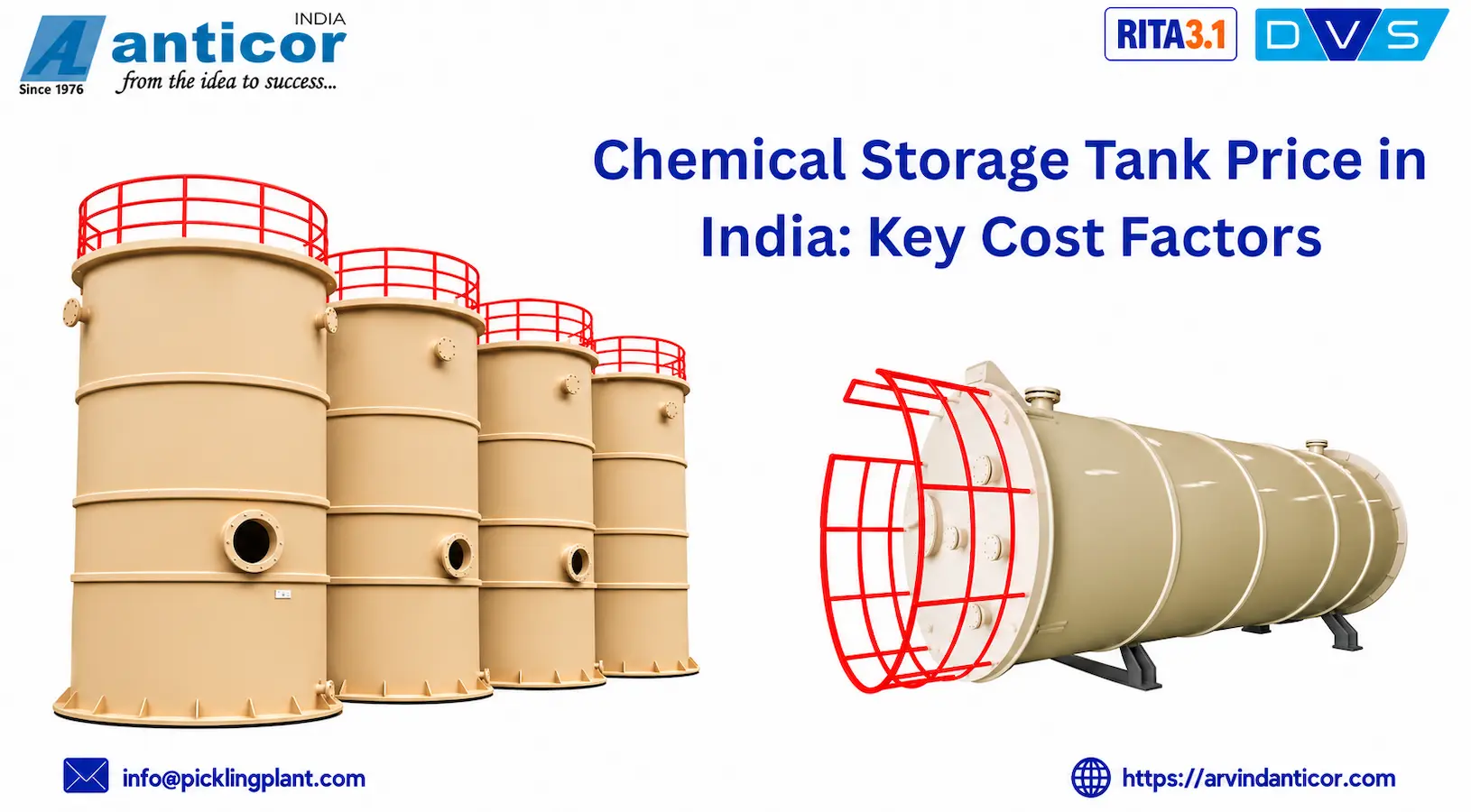
Ask two manufacturers to quote the same tank and you’ll often walk away with two very different numbers. That’s not a sales tactic. A chemical storage tank isn’t really a single product with a single price. The chemical going into it, the material chosen, the operating conditions, the design, how it’s actually fabricated — all of it shapes the final cost, and move any one piece and the number moves with it.
Buying a storage tank for an industrial facility isn’t quite like ordinary procurement. Someone still has to sign off on the engineering. The tank has to match the chemical it’ll hold, take real operating loads day after day, and do that reliably for years. Most facilities, when you get down to it, are really looking for corrosion-resistant chemical storage tanks that won’t need replacing in a couple of years. If you know what’s actually pushing the cost up or down, a quotation stops being a mystery number and starts making sense — and you’re less likely to grab something that looks cheap today and ends up costing double by year three.
Why There’s No Single Price for a Chemical Storage Tank
You can’t shop for a chemical storage tank the way you’d shop for a drum off a shelf. It’s built around what you’re storing, how much, under what conditions, for how long — change any of that and the price shifts too. Ambient-temperature water storage calls for a different material and build than holding a concentrated acid does, and even two tanks in the identical material can land at different numbers once wall thickness, dimensions, fittings, and fabrication enter the picture.
A credible price estimate, then, doesn’t start with a rate card. It starts with your actual application — which is really the only honest way to talk about chemical storage tank price in India, given how much the number can swing.
Key Factors That Influence Chemical Storage Tank Cost
1. Material Selection
Material is usually the single biggest cost driver. Raw material expense, how the tank gets built, how it holds up over the years — material touches all three.
HDPE chemical storage tanks (High-Density Polyethylene) are a common starting point. Solid chemical resistance, good impact strength, fabrication that’s relatively straightforward. They handle a wide range of alkalis and common process chemicals without much trouble, and being lighter keeps handling and installation costs down too. The catch is temperature — HDPE sits toward the lower end of the range, so it’s usually the right pick for ambient or moderately warm applications, not for anything running hot.
PP chemical storage tanks (Polypropylene, including Polypropylene Homopolymer) go further. Better temperature tolerance, broader chemical compatibility, including stronger acids and solvents that would push an HDPE tank past its limits. That wider operating window usually means more specialized fabrication. But for hotter or more aggressive applications, a PP chemical storage tank often ends up cheaper over time than an HDPE tank that fails early because it was never really spec’d for the job.
Polypropylene Copolymer, or PPC, trades some of PPH’s rigidity for flexibility and impact resistance. Good option if the tank is going to face mechanical stress or vibration during regular use.
FRP chemical storage tanks (Fibre-Reinforced Plastic) bring fiberglass reinforcement into the build, adding structural strength that thermoplastics alone don’t offer. Common choice for larger capacities, or anywhere structural rigidity matters as much as chemical resistance — FRP is often where engineers land when they need genuinely corrosion-resistant chemical storage tanks at scale. That extra reinforcement does add to both material and labor cost.
Stainless steel is usually reserved for high-temperature work or chemical compatibility needs plastics can’t meet — pricier raw material, and a fabrication process that doesn’t resemble thermoplastic or FRP construction much at all.
Depending on the material, these tanks run efficiently anywhere from -20°C up to 120°C, which is a big part of why this range of materials dominates industrial chemical storage tanks across the country. What’s actually suitable, though, comes down to the specific material and chemical involved. There’s no universal “best” here. Each option solves a particular combination of chemical compatibility, temperature, and structural demand, and picking by price before confirming compatibility is a fairly reliable way to end up replacing a tank earlier than planned.
2. Capacity and Tank Dimensions
Capacity decides how much raw material a tank needs, but it’s not the only variable. Diameter, height, wall thickness, and configuration all affect material use and structural requirements, and bigger tanks generally need more reinforcement and more careful handling during fabrication and transport.
Liquid density plays its own role. A tank holding something dense carries more hydrostatic load than a same-capacity tank holding something lighter, and that can push up the wall thickness you need.
Sizing a custom chemical storage tank around your actual operating numbers, rather than whatever a standard capacity sheet offers, is what keeps costs proportional. Before you request a quote, a few things are worth figuring out:
- Daily or process consumption — how much of the chemical you actually use or produce in a typical cycle
- Storage buffer — how many days or batches of supply you want on hand
- Peak demand — whether consumption spikes at certain times, and whether the tank needs sizing around that peak
- Available installation space — floor area and height often decide whether one large tank or a few smaller ones makes more sense
- Future expansion — a bit of headroom now can beat replacing or adding a tank later
Go too small and you’re refilling constantly. Go too big and you’re paying for capacity and structural support that just sits there, doing nothing. Most industrial chemical storage tanks fall somewhere between 5,000 and 50,000 litres, and custom sizing is available for whatever falls outside that range — no need to round up to the nearest standard option just because that’s what’s listed. The right capacity for industrial chemical storage tanks of any kind comes down to your actual operating numbers, not a catalog default.
3. Design and Configuration
A tank’s shape and orientation decide how much material and labor go into building it. Vertical and horizontal configurations carry different structural requirements, depending on where the tank is actually going. Wall thickness gets adjusted for the chemical being stored, its concentration, and operating temperature — thicker walls, more material, more fabrication time. A custom chemical storage tank shape or non-standard dimension, say to fit a particular site layout, usually needs more design and engineering input than a standard cylindrical tank would.
One design option worth knowing about: Tank-in-Tank systems, used where secondary containment is required. An inner storage tank sits inside an outer containment tank, adding a layer of protection against leakage. Genuinely useful when you’re dealing with corrosion-resistant chemical storage tanks holding something hazardous. Extra material and fabrication, so it’s something to raise with your supplier early if your application calls for it.
4. Fittings and Accessories
The tank shell is just one piece of a complete storage system. Nozzles, manways, level indicators, venting systems, inlet and outlet configurations — each adds to the cost, and exactly which combination you need depends on how the tank gets used day to day. Get clear early on what’s standard and what needs specifying separately, whether you’re buying one tank or fitting out a full line of industrial chemical storage tanks. This is where a quoted price and a final invoice most often part ways.
5. Welding and Fabrication Standards
How reliably a tank performs over its service life traces back, in large part, to fabrication quality. Thermoplastic tanks need the right welding procedure, equipment, and process control — DVS Technical Codes set the relevant standard here. Certified procedures cost more to maintain, but that’s money buying reliability you can’t verify just by eyeballing a finished tank.
So when quotes land on your desk, ask about welding method, applicable standards, inspection practices. The number at the bottom isn’t the whole story, and it’s usually the welding that decides whether you’re actually getting corrosion-resistant chemical storage tanks or just something that looks the part on day one.
6. Customization and Engineering
A custom chemical storage tank manufacturer works from your specific operating and installation requirements instead of a standard size chart, and that extra design and engineering effort shows up in what you pay. Non-standard capacities, special nozzle arrangements, structural supports, integration with existing equipment — any of it adds work toward a genuinely custom chemical storage tank rather than a slightly modified standard one. Sharing accurate operating data upfront saves you from design revisions and delays later.
7. Transportation and Installation
What a quoted tank price covers varies — transportation, unloading, foundation work, and site commissioning aren’t always included. Shipment distance, dimensions, and special handling all factor into transport cost, and this matters more for bulkier industrial chemical storage tanks than for anything small enough to move by hand. Installation hinges on site accessibility, foundation readiness, and how much of that work the manufacturer is actually taking on.
What’s Included in the Total Cost?
The tank’s purchase price is one line item in a bigger picture. Engineering, fabrication, accessories, inspection, transportation, installation, and integration with existing plant systems can all be part of total cost, depending on the project. A manufacturer quoting a lower chemical storage tank price in India might just be excluding accessories or installation someone else bundles in by default — once that’s accounted for, the gap between two quotes often shrinks or disappears. Put together a clear scope of supply first, so the comparison is genuinely fair.
How to Compare Chemical Storage Tank Quotations
A lower number by itself doesn’t mean much. Check first whether each quote is covering the same technical ground. Material suitability for your chemical comes first, then capacity, dimensions, wall thickness, nozzle configuration. Where secondary containment applies, make sure the quote accounts for both the primary tank and the Tank-in-Tank arrangement — not the inner vessel alone.
After that, fabrication quality deserves a look: welding procedure, inspection and testing, warranty terms, delivery timeline, after-sales support. Confirm transportation and installation status too. Comparing like for like really is the only way to judge cost, quality, and long-term fit honestly.
Why Choosing on Price Alone Can Cost More Long-Term
The lowest number on the page can look like the easy choice, but it rarely reflects the real cost of ownership. A tank that’s a poor match for the stored chemical or operating temperature can wear out early, leak, or demand maintenance nobody planned for — and that tends to show up later as repair bills, downtime, or in the worst cases, genuine safety and environmental trouble.
A sounder decision weighs material compatibility, design, fabrication quality, and expected service conditions right alongside the price tag, not after it. The point was never finding the cheapest tank in the room. It’s finding genuinely corrosion-resistant chemical storage tanks that actually do the job, year after year.
How Arvind Anticor Prices a Custom Chemical Storage Tank
As chemical storage tank manufacturers in India, we build every quote around the actual application: the chemical being stored, required capacity, operating conditions, tank configuration, fittings, and installation requirements. Our range spans polypropylene chemical storage tanks, HDPE, and FRP construction, all built as corrosion-resistant chemical storage tanks suited to demanding industrial environments and where secondary containment comes into play, we can design a Tank-in-Tank arrangement into the project too.
A generic price list just doesn’t hold up across that many variables, which is really the whole reason chemical storage tank price in India varies as much as it does from one supplier to the next. Share more detail upfront, and we can scope and quote closer to what you actually need, rather than what a standard size sheet assumes.
Conclusion
Chemical storage tank price in India comes down to material, capacity, design, fittings, fabrication standard, customization, and installation, working together — not a single fixed figure anyone can quote off the top of their head. Walk into that conversation with a clear picture of these factors, and you’ll be able to read a quotation properly instead of judging it purely on the bottom line.
Arvind Anticor Limited brings decades of experience engineering chemical storage tanks for demanding industrial applications, backed by ISO and ASTM-compliant manufacturing standards. Whether you need a custom chemical storage tank for a tricky site and an unusual chemical, or standard industrial chemical storage tanks for routine process work, our team can help you scope the right solution and put together a custom quote built around what you actually need.
Let’s Connect
Contact Us
We are live 24/7 and reply within 48 hours.
Get in Touch
-
-
-
Address
Survey No.584/1+2 – C,Nr. Akshar Industrial Estate Mahemdabad Highway Road,Vatva Ahmedabad-382445, Gujarat, India.