

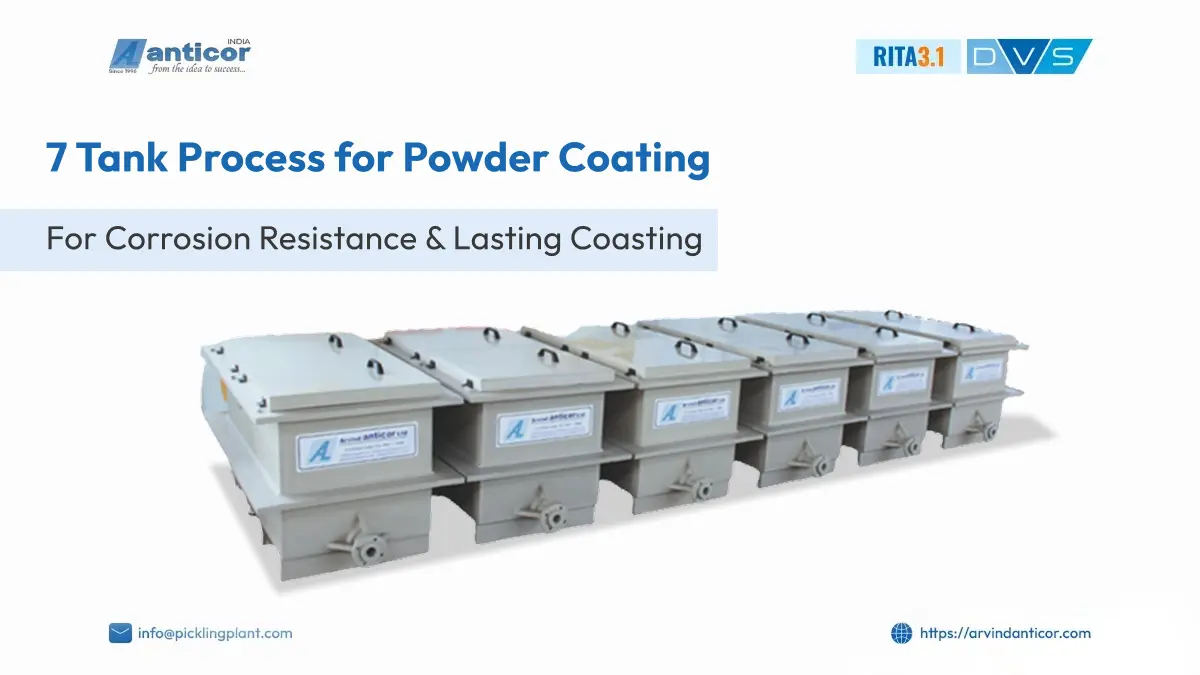
In the world of industrial coating, surface preparation is more than just a preliminary step. It’s the foundation of quality. The 7 Tank Phosphating Process for Powder Coating remains one of the most trusted and widely used methods to ensure that metal surfaces are clean, corrosion-resistant, and ready for a flawless powder coat application.
Whether you’re coating automotive chassis, industrial enclosures, structural steel components, or heavy machinery parts, poor surface preparation can lead to coating failures like peeling, corrosion, or reduced operational life. That’s where the seven tank process for powder coating plays a vital role, delivering a uniform, chemical-based pretreatment that significantly boosts both adhesion strength and long-term durability in harsh working environments.
In this guide, we’ll break down the 7-tank process for powder coating, explore what happens in each tank, and explain why this method continues to be the industry standard across manufacturing plants globally in 2025 and beyond.
What is the 7 Tank Process for Powder Coating?
The 7 Tank Process for Powder Coating is a multi-stage surface pretreatment method used to clean, decontaminate, and chemically prepare metal surfaces before powder coating is applied. It involves a sequence of seven chemical treatments, each designed to remove oils, rust, and oxides, and finally apply a phosphate layer that improves corrosion resistance and enhances coating adhesion.
This process is commonly used on mild steel, galvanized iron, and cast or fabricated industrial components. It’s a standard in sectors such as automotive manufacturing, heavy equipment fabrication, defense engineering, and industrial machinery production, where long-term durability and finish quality are non-negotiable.
Unlike basic cleaning methods, the seven tank process for powder coating is not just about surface cleanliness. It’s about transforming the substrate into a chemically stable, adhesion-ready surface through controlled chemical reactions at each stage.
By combining degreasing, descaling, phosphating, and passivation, the 7-tank method ensures that your powder coat doesn’t just look good. It lasts through real-world wear and tear.
7 Tank Phosphating Process in Powder Coating Pretreatment
The 7-tank phosphating process is a key part of the powder coating pretreatment process, used to prepare metal surfaces for strong coating adhesion and corrosion resistance.
As a complete metal surface pretreatment method, it removes contaminants, treats the surface chemically, and creates a stable base for coating.
In industrial applications, the phosphating process for powder coating improves durability in environments exposed to moisture, chemicals, and outdoor conditions.
For higher corrosion resistance, the zinc phosphating process is widely used, forming a protective layer that enhances coating performance.
Step-by-Step Breakdown of the Seven Tank Process for Powder Coating
The seven tank process for powder coating is structured around a carefully sequenced chemical treatment workflow. Each tank serves a specific purpose, from removing surface contaminants to creating a chemically active layer that enhances powder adhesion and corrosion resistance.
Let’s walk through what happens at each stage:
Tank 1: Degreasing
The first tank uses an alkaline chemical solution to remove grease, oil, dirt, and shop contaminants from the metal surface. This ensures that no residue interferes with chemical bonding in later stages.
Common chemicals: Sodium hydroxide-based degreasers.
Tank 2: Water Rinse 1
This rinse removes leftover alkaline cleaner and floating contaminants from the surface. It prevents cross-contamination in the following acid-based stages.
Usually plain or softened water is used.
Tank 3: De-rusting / Descaling
Here, acidic solutions such as phosphoric acid or a blend of acids dissolve rust, scale, and oxidation from the surface. This is especially important for mild steel or weather-exposed components.
This step directly exposes the base metal, preparing it for phosphate bonding.
For tanks that hold strong acids, using corrosion-resistant materials is crucial. At Arvind Anticor, we manufacture PP and FRP pickling tanks designed specifically to handle acid-based treatment lines with safety and durability.
Tank 4: Water Rinse 2
Removes acid residue from the de-rusting stage. Prevents over-etching and balances surface pH before phosphating.
Tank 5: Phosphating
The most critical stage. This tank applies a zinc or iron phosphate coating onto the clean metal surface.
This phosphate layer is microscopically porous, providing mechanical anchoring sites for the powder coating and improving corrosion resistance significantly.
Zinc phosphate is preferred for industrial-grade durability.
Tank 6: Water Rinse 3
Washes off any unreacted phosphating solution and fine sludge. Ensures a clean, even coating without residue before the final sealing.
Tank 7: Passivation / Drying
This final step often includes either:
A hot water rinse or chromate sealing to passivate the phosphate layer, or
Air drying in controlled heat zones to fully remove moisture.
It adds stability and enhances shelf life if there’s a delay between pretreatment and coating.
Together, these stages form a robust and repeatable phosphating process that enables powder-coated components to resist corrosion, impact, and wear even in rugged outdoor and industrial environments.
Benefits of the 7 Tank Phosphating Process for Powder Coating
The 7 tank phosphating process for powder coating isn’t just a cleaning method. It’s a precise surface treatment that adds significant performance value to industrial coatings. Here’s why this process continues to be the standard in sectors requiring high durability and corrosion protection:
1. Enhanced Coating Adhesion
The phosphate layer created during phosphating forms a micro-porous surface that promotes strong mechanical bonding with the powder coat. This results in improved adhesion and minimizes the risk of peeling or chipping.
2. Improved Corrosion Resistance
By chemically converting the metal surface into a protective phosphate layer, the process shields the base metal from moisture, chemicals, and air exposure. This helps prevent rust and degradation in challenging environments.
3. Longer Coating Life in Harsh Conditions
Phosphated components demonstrate better resistance to corrosion, humidity, and salt spray — making this process ideal for industrial parts used in construction, logistics, agriculture, and outdoor applications.
4. Uniform and Clean Surface Preparation
Each stage of the 7 tank process is designed to remove specific contaminants: oils, rust, oxides, and particulates, ensuring a clean and uniform substrate, which leads to consistent coating thickness and a high-quality finish.
5. Lower Rework and Maintenance Costs
The initial investment in a proper phosphating line pays off through fewer coating failures, reduced downtime, and fewer returns or rejections. For long-term production, it’s a highly cost-effective solution.
When to Use the Seven Tank Process for Powder Coating
The seven tank process for powder coating is not always necessary for every type of metal or application. However, it becomes essential when the end product is expected to perform in tough environmental, industrial, or operational conditions. Here’s when it should be your go-to surface treatment method:
For Mild Steel and Industrial-Grade Metals
Mild steel is prone to rust and scale buildup, making it unsuitable for direct powder coating without proper pretreatment. The 7 tank process effectively removes rust, degreases the surface, and chemically bonds a phosphate layer, preparing it for long-term performance.
For Outdoor or Harsh Environment Applications
If your components are exposed to moisture, chemicals, temperature shifts, or abrasion, such as in construction machinery, transport vehicles, or infrastructure installations, this process adds a critical layer of corrosion protection beneath the powder coating.
For High-Adhesion Coating Requirements
In industries where the powder coating must last through mechanical wear, vibration, or repeated cleaning (like in defense, agriculture, or mining equipment), the 7 tank phosphating process ensures the powder coat adheres securely to the metal.
For OEMs and Heavy Manufacturing Units
Original Equipment Manufacturers (OEMs) and large-scale fabricators often deal with strict quality requirements. The 7 tank process helps meet these by ensuring surface readiness, finish consistency, and compliance with performance specifications.
Chemicals Used in Each Stage of the Phosphating Process
The 7 tank phosphating process for powder coating relies on a sequence of specific chemical treatments. Below is a simplified view of the chemicals and their roles at each stage:
| Tank | Process | Chemical Type | Purpose |
| 1 | Degreasing | Alkaline cleaner (NaOH, surfactants) | Removes oils, grease, and dirt from the surface |
| 2 | Water Rinse 1 | Soft/demineralized water | Washes off residual degreaser |
| 3 | Derusting / Descaling | Phosphoric or hydrochloric acid | Removes rust, oxides, and scale from the metal |
| 4 | Water Rinse 2 | Soft or tap water | Neutralizes acid and prevents over-etching |
| 5 | Phosphating | Zinc or iron phosphate solution | Forms a phosphate layer for adhesion and corrosion resistance |
| 6 | Water Rinse 3 | Clean softened water | Removes loose phosphating residues and sludge |
| 7 | Passivation / Drying | Chromate seal or hot DI water (optional) | Seals the phosphate layer or dries the component |
Common Issues in the 7 Tank Phosphating Process and How to Prevent Them
Even with a well-defined sequence, the 7 tank phosphating process for powder coating can deliver inconsistent results if key operating parameters are not properly controlled. In most cases, coating failures are not caused by the process itself but are typically due to variations in chemical control, rinsing efficiency, and maintenance practices within the 7 tank process for powder coating.
One of the most common issues is incomplete degreasing. Residual oils and shop contaminants interfere with chemical reactions in later stages, resulting in poor phosphating and weak coating adhesion. Maintaining correct chemical concentration, temperature, and contact time in the degreasing stage is essential for effective performance of the phosphating process for powder coating.
Cross-contamination between tanks is another major concern. Ineffective rinsing allows alkaline or acidic carryover to disrupt the chemistry of subsequent stages, reducing bath life and overall process efficiency. Properly designed rinsing systems and controlled overflow mechanisms are critical to maintaining process stability.
During the phosphating stage, uneven coating formation can occur due to:
- Incorrect bath temperature
- Poor chemical dosing
- Sludge buildup at the tank bottom
These factors directly affect coating consistency and corrosion resistance. Regular bath monitoring and sludge removal are necessary to maintain a uniform phosphate layer.
Lastly, improper drying or delayed coating can lead to flash rusting, especially in humid environments. Controlled drying systems or immediate powder application help preserve the treated surface.
In industrial operations, these challenges are minimized through proper system design, material selection, and consistent process control, ensuring consistent and reliable pretreatment performance.
7 Tank Process for Powder Coating vs. 3-in-1 Chemical Systems
As industries modernize their coating lines, many manufacturers are comparing the traditional 7 tank process for powder coating with newer 3-in-1 chemical pretreatment systems. Each approach has its place — the right choice depends on your production scale, quality expectations, and type of components.
Below is a side-by-side comparison:
| Aspect | 7 Tank Process for Powder Coating | 3-in-1 Chemical Systems |
| No. of Stages | 7 distinct tanks (degreasing, derusting, phosphating, etc.) | Typically, 1–3 combined steps in fewer tanks |
| Surface Quality | High-performance prep for industrial-grade coating | Moderate prep suitable for indoor or less demanding use |
| Corrosion Resistance | Excellent (especially with zinc phosphate) | Good, but generally lower than full 7-tank process |
| Adhesion Strength | Superior adhesion due to porous phosphate layer | Acceptable for lighter-duty coatings |
| Time & Space Required | More time and factory floor space | Faster processing with compact layout |
| Best Used For | Heavy-duty parts, outdoor machinery, automotive, defense | Electrical panels, indoor furniture, general enclosures |
| Operational Cost | Higher initial setup and maintenance | Lower setup cost and reduced chemical usage |
When Should You Use the 7 Tank Process?
Stick with the 7 tank phosphating process for powder coating when:
- Your components are exposed to harsh environments
- You’re working with mild steel or heavily rusted surfaces
- Product lifespan and quality assurance are priorities
Why the 7 Tank Phosphating Process Still Matters
In a manufacturing world moving toward speed and automation, the 7 tank phosphating process for powder coating continues to stand out for one reason: reliability. When coating durability, corrosion resistance, and adhesion strength are mission-critical, this time-tested method consistently delivers.
Industries like automotive, heavy machinery, infrastructure, and defense rely on this process not just to meet standards, but to exceed them. While newer 3-in-1 systems offer speed, they rarely match the depth of surface preparation and long-term performance provided by a properly maintained seven tank line.
If your business involves outdoor equipment, structural steel, fabricated parts, or components exposed to harsh conditions, investing in a 7 tank phosphating setup is still the best insurance for coating longevity.
Conclusion
At Arvind Anticor, we understand that the strength of any powder coating process begins with precise surface preparation. The 7 tank phosphating process for powder coating remains a cornerstone for industries demanding high performance, longevity, and corrosion resistance, and we’ve spent decades helping manufacturers build these systems right. This process is commonly implemented in a complete powder coating phosphating plant, ensuring consistent treatment quality and long-term operational reliability.
Whether you’re upgrading an existing setup or building a new treatment line from scratch, our team offers end-to-end support, from acid-resistant pickling tanks and custom-built surface treatment plants to turnkey installation and after-sales service.
Let’s Connect
Contact Us
We are live 24/7 and reply within 48 hours.
Get in Touch
-
-
-
Address
Survey No.584/1+2 – C,Nr. Akshar Industrial Estate Mahemdabad Highway Road,Vatva Ahmedabad-382445, Gujarat, India.